
 Español
Tribute to Juan Lerma’s Scientific Career
28 de September de 2026
- The IN CSIC-UMH has brought together researchers from Spain, the United Kingdom and Portugal who have shared different stages of Juan Lerma’s scientific career.
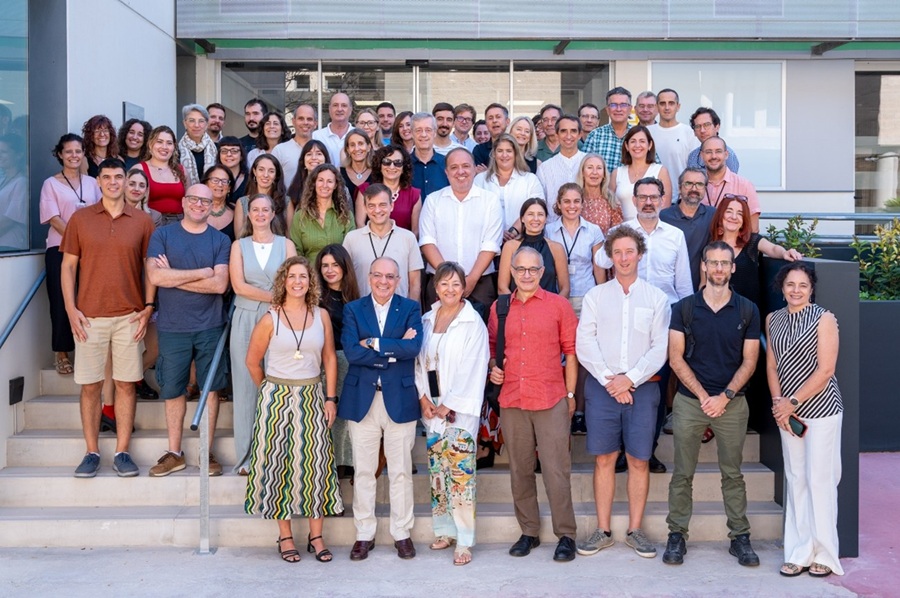
Group photo of many of the participants in the tribute to Prof. Lerma. Source: IN CSIC-UMH.
The Institute for Neurosciences (IN), a joint centre of the Spanish National Research Council (CSIC) and Miguel Hernández University of Elche (UMH), hosted a special event last Friday to celebrate Juan Lerma's scientific career, CSIC Research Professor ad honorem at the IN. The event brought together researchers who have maintained scientific and personal ties with Lerma over the years, with the aim of highlighting his contributions to the advancement of neuroscience, his role as a mentor, and his influence on the training of new generations of researchers.
Throughout the day, the programme brought together scientists from institutions in Spain and abroad, many of them former members of Lerma’s laboratory or collaborators he has worked with throughout his career. The event featured Miguel Maravall, from the University of Sussex (UK); Rafael Fernández Chacón, Director of the Institute of Biomedicine of Seville (IBiS); Sergio Valbuena and Rocío Rivera, former members of Lerma’s laboratory; Laura L. Mascaraque, researcher at the Cajal Institute for Neuroscience (CSIC); Ricardo J. Rodrigues, from the Center for Neuroscience and Cell Biology at the University of Coimbra (Portugal); and Óscar Marín, researcher at King’s College London (UK).
The tribute also included strong representation from the Institute for Neurosciences CSIC-UMH, with the participation of Guillermina López-Bendito; Mª Teresa García Hedo, the centre’s manager; Ana Valero Paternain, a member of Lerma’s laboratory; Julio Barbas; Santiago Canals; Carlos Belmonte, Emeritus Professor at UMH and founder of the Institute for Neurosciences; Ángela Nieto; and Juana Gallar, the Institute’s current director, who served as deputy director during Lerma’s tenure as head of the centre.
The tribute aimed to bring together researchers with whom Lerma has shared projects, collaborations and different stages of his career, whose contributions highlighted the impact these scientific relationships have had both on their own careers and on the neuroscience community.
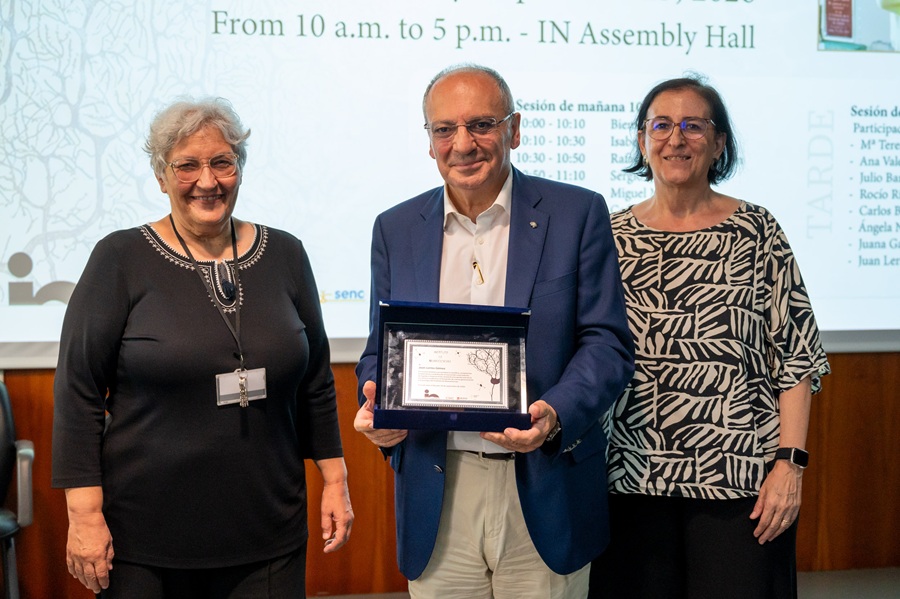
Juan Lerma received an honorary plaque from the Institute Director Juana Gallar (left) and Manager Mª Teresa García Hedo (right). Source: IN CSIC-UMH.
Ana Valero, a member of Lerma’s team for more than three decades, explained that organising the tribute was also an opportunity to recognise both the scientific and personal dimensions of a shared journey: “For me, it has been a great source of excitement and, at the same time, a privilege to organise this tribute. My lab colleagues and I have put a great deal of care and dedication into this project, to celebrate not only his career and scientific contributions, but also everything he has meant to those of us who have had the good fortune to be part of his team”.
More than four decades dedicated to neuroscience
Juan Lerma was born in Moral de Calatrava (Ciudad Real) and moved with his family to Madrid, where he studied Biology at Complutense University of Madrid. He began his research career at Ramón y Cajal Hospital and earned a PhD in Science from the Autonomous University of Madrid in 1983. He subsequently worked at the Albert Einstein College of Medicine in New York (USA), where he made important contributions to the understanding of NMDA synaptic receptors. After returning to Spain, he continued his career at the Cajal Institute of the CSIC and, in 2004, joined the Institute for Neurosciences with his research group.
His research has focused on understanding the mechanisms that allow neurons to communicate with one another, with particular attention to glutamate receptors and, especially, kainate receptors. His work has contributed to advancing our understanding of the molecular and cellular mechanisms that regulate synaptic communication and plasticity.
Throughout his career, he has published more than 100 scientific papers and received several distinctions, including the Gold Medal of the Institute for Neurosciences and the Distinction for Scientific Merit awarded by the Generalitat Valenciana. In 2024, he was elected a full member of the Royal Academy of Exact, Physical and Natural Sciences of Spain.
His work has extended beyond his own laboratory. Lerma has held various positions in national and international scientific organisations and served as President of the Spanish Society of Neuroscience (SENC) from 2011 to 2013. This commitment to the scientific community is one of the aspects that the tribute organisers sought to highlight alongside his research contributions and his role in training new generations of researchers.
Contributing to the consolidation of the Institute for Neurosciences
Juan Lerma’s career is closely linked to the development of the Institute for Neurosciences. After joining the centre in 2004, he became its Deputy Director in 2005, during Carlos Belmonte’s tenure as Director. Belmonte had led the centre since its establishment in 1990. In 2007, Lerma succeeded Belmonte as Director of the IN, a position he held until 2016.
His tenure as Director coincided with a decisive period in the Institute’s growth and consolidation. In 2007, the IN received research funding through the Consolider-Ingenio programme, which provided a solid foundation for the centre’s growth and consolidation as a national reference in neuroscience research. This was followed in 2014 by the Institute’s first Severo Ochoa Centre of Excellence accreditation, a recognition that the IN has subsequently renewed and which has contributed to consolidating its position as a leading centre in neuroscience.
Following his retirement last year, Juan Lerma remains affiliated with the Institute for Neurosciences as a CSIC Research Professor ad honorem. The tribute was organised by members of his team and scientific collaborators, with financial support from the Spanish Society of Neuroscience (SENC).
Source: Institute for Neurosciences CSIC-UMH (in.comunicacion@umh.es)