
 Español
Project Sagutxoa: studying rare neurodegenerative diseases using neurons derived from baby teeth
22 de September de 2026
- A team supported by The Walk On Project Foundation (WOP) proposes combining patient-derived neuronal models with artificial intelligence and quantum computing.
- Institute for Neurosciences UMH-CSIC researcher Salvador Martínez will lead the project’s scientific team.
The Walk On Project Foundation (WOP) is promoting Sagutxoa, a research proposal that aims to explore new approaches to the study of rare neurodegenerative diseases by analysing neurons obtained from patients’ baby teeth. The initiative proposes applying artificial intelligence (AI) and quantum computing tools to analyse data generated from these cellular models.
Salvador Martínez, Professor at Miguel Hernández University of Elche (UMH) and researcher at the Institute for Neurosciences (IN), a joint centre of UMH and the Spanish National Research Council (CSIC), is participating in the proposal and will lead the project’s scientific team. The initiative is currently at a preliminary stage, during which the feasibility of this approach and the potential of the project’s methodology will be assessed.
The project is based on baby teeth from children with rare neurodegenerative diseases. Cells can be obtained from dental pulp and, through cellular reprogramming techniques, can give rise to neurons with characteristics of the patients from whom they originate. These cellular models make it possible to study certain aspects of the diseases in the laboratory and generate data from different experimental tests.
“The possibility of having patient-derived neurons allows us to study disease-related characteristics in the laboratory and analyse how these cells respond to different experimental conditions”, explains Salvador Martínez. The researcher points out that the aim of this first phase is to test the process as a whole and assess what information can be obtained from these models.
The technical development of the project is planned to take place at the partners’ facilities in the Basque Country and the Valencian Community. The collection of baby teeth is carried out following a standardised protocol and with the necessary legal safeguards for their subsequent use in research, including informed consent for their donation to a public biobank within the national network of the Carlos III Health Institute.
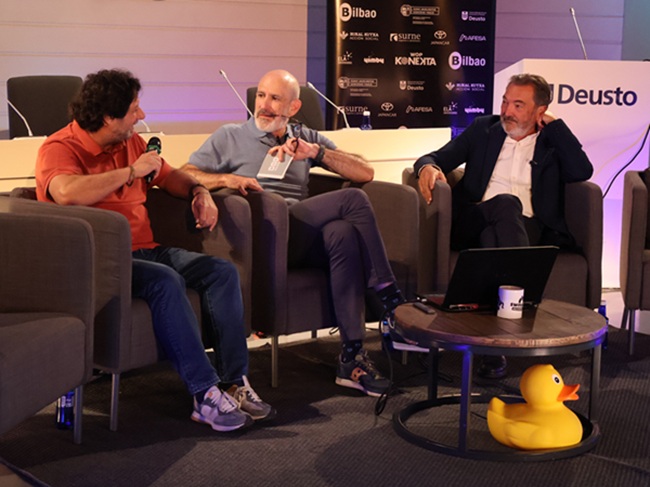
From left to right: Aitor Moreno, Mikel Renteria and Salvador Martínez at an event held in Bilbao.
The project proposes carrying out different tests on the neurons obtained from the teeth and collecting large volumes of data. In this context, Aitor Moreno, a researcher specialising in artificial intelligence (AI), quantum computing and neurocomputing, leads the LKS Next team involved in the initiative. “We can carry out many tests on these laboratory neurons from different children with the same disease, collect huge amounts of data and link them with anonymised data on the patients’ environment. We apply quantum computing to this pool of data to look for hidden patterns in the diseases that could provide clues for new treatments”, says Moreno.
For his part, Mikel Renteria, President of the WOP Foundation, describes the initiative as a major milestone: “We have become actively involved in this project that we are promoting, from the very conception of the initiative through to its development. This step is the result of many previous ones and is made possible by the collective effort of all the people and organisations that support WOP in its day-to-day work and through our activities. We would especially like to thank LKS Next and the Institute for Neurosciences (UMH-CSIC) for making it possible. We remain committed to our promise and our dream”.
A budget of €120,000 is envisaged for this initial phase. The Eroski Foundation has also decided to support the project, which is expected to become a research line that can continue over time. The aim is to obtain initial results that will help assess the potential of this approach: “If everything goes well, there is no doubt that we will secure the resources to continue it and apply it to as many diseases as possible”, says Renteria.
About WOP
For the past 16 years, WOP has allocated the proceeds from all its activities to research into therapies for neurodegenerative diseases. To date, it has allocated €1.5 million to research into neurodegenerative diseases through several international projects.
Website: www.walkonproject.org
More information (Spanish): https://elpais.com/espana/pais-vasco/2026-09-18/un-ensayo-aplica-la-computacion-cuantica-a-las-neuronas-obtenidas-de-dientes-de-leche.html
Source: Institute for Neurosciences UMH-CSIC (in.comunicacion@umh.es)