
 Español
The Institute for Neurosciences brings together international leaders at the ‘Mechanobiology of Physiological Systems’ conference
25 de May de 2026
- The meeting brought together international leaders in mechanotransduction, sensory neuroscience, and developmental biology, fostering new collaborations in a key field for biomedicine.
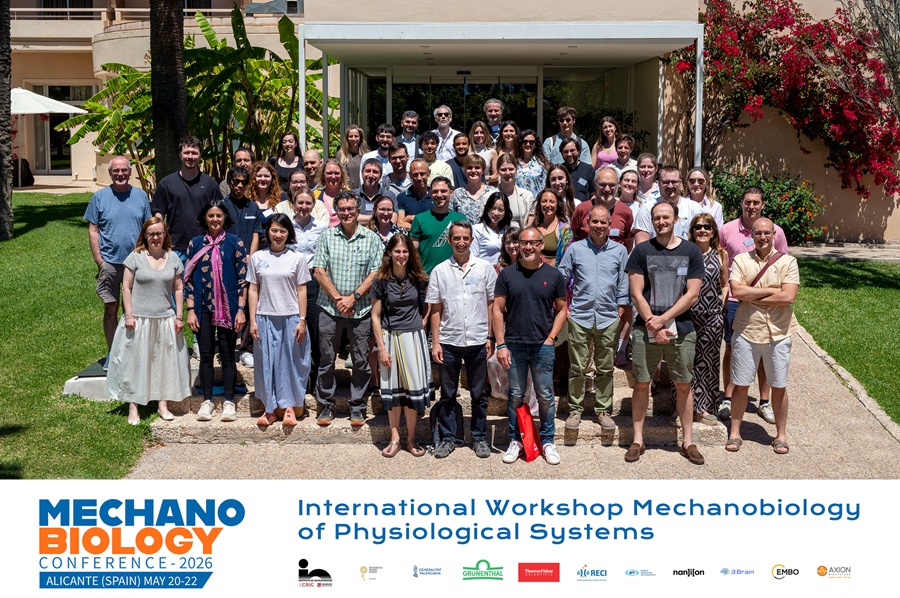
Official group photo of the international conference ‘Mechanobiology of Physiological Systems’ participants, held in Sant Joan d’Alacant. Source: IN CSIC-UMH.
The Institute for Neurosciences (IN), a joint center of the Spanish National Research Council (CSIC) and the Miguel Hernández University of Elche (UMH), hosted the international conference ‘Mechanobiology of Physiological Systems’ from May 20 to 22. The scientific meeting brought together international experts in mechanobiology in Sant Joan d’Alacant, an emerging discipline that studies how physical and mechanical forces influence the functioning of cells and tissues.
The workshop, organized locally by IN CSIC-UMH researchers Francisco J. Taberner, Ana Gomis, Víctor Borrell, and Félix Viana, brought together experts from leading institutions in Europe and the United States to discuss the latest advances in mechanotransduction, neural development, sensory perception, mechanical pain, and cellular dynamics, among other research areas. The event featured a scientific program consisting of plenary lectures, invited talks, short communications, and poster sessions.
The scientific sessions addressed topics such as the role of PIEZO mechanosensitive channels in brain and cardiovascular development, the cellular mechanisms involved in mechanical pain, tissue repair, neuronal migration, and the mechanical organization of tissues during embryonic development.
The program included a series of keynote lectures that formed the backbone of the meeting. Highlights included the EMBO Lecture by Gary Lewin (Max Delbrück Center for Molecular Medicine, Berlin), focused on the molecular mechanisms of touch, as well as plenary lectures by Pere Roca-Cusachs (University of Barcelona), on the regulation of mechanotransduction from integrins to the nucleus; Yanlan Mao (University College London), on tissue responses to mechanical stress during development and repair; Marcos Sotomayor (University of Chicago, USA), on the molecular mechanisms of mechanical sensory perception; Medha Pathak (University of California, Irvine, USA), on the role of PIEZO1 in development and tissue repair; and Ellen Lumpkin (University of California, Berkeley, USA), on the ion channels involved in touch and mechanical pain.
The program also featured a strong participation from researchers at the IN CSIC-UMH. Contributions included those by Francisco Taberner (Wiring and Function of Somatosensory Circuits Laboratory), focused on the role of PIEZO channels in mechanotransduction; Jorge Fernández-Trillo (Sensory Transduction and Nociception Laboratory), on the role of PIEZO2 in nociceptors involved in mechanical pain; Augusto Escalante (Generation and Regeneration of Bilateral Neural Circuits Laboratory), on spinal circuits involved in mechanical itch; Sergio Sarrió-Fernández (Wiring and Function of Somatosensory Circuits Laboratory), on tools for the characterization of mechanosensitive channels; Víctor Borrell (Neurogenesis and Cortical Expansion Laboratory), on the relationship between tissue mechanics and cortical folding formation; and José Carlos Pastor Pareja (Cell-to-tissue Architecture in the Nervous System Laboratory), on the mechanical properties of basement membranes in tissues.
In addition to promoting scientific exchange among researchers from different disciplines, the meeting helped strengthen new international collaborations in a field with significant biomedical implications. Mechanobiology has become a key tool for understanding physiological processes and pathologies related to brain development, cardiovascular diseases, cancer, and sensory disorders.
The organization of this workshop reinforces the role of the IN CSIC-UMH as an international leading center in biomedical research and neuroscience, as well as its commitment to hosting high-level scientific meetings and promoting international research networks.
Este congreso ha sido posible gracias al apoyo de las compañías Grünenthal, Axion Biosystems, 3 Brain, Thermo Fisher Scientific, Nanion Technologies y World Precision Instruments; la Red Española de Canales Iónicos (RECI); la Organización Europea de Biología Molecular (EMBO); la Generalitat Valenciana; y el Programa Severo Ochoa para Centros de Excelencia.
This conference was possible thanks to the support of the companies Grünenthal, Axion Biosystems, 3Brain, Thermo Fisher Scientific, Nanion Technologies, and World Precision Instruments; the Spanish Ion Channel Network (RECI); the European Molecular Biology Organization (EMBO); the Generalitat Valenciana; and the Severo Ochoa Program for Centers of Excellence.
Source: Institute for Neurosciences CSIC-UMH (in.comunicacion@umh.es)