
 Español
A study by Fisabio and the IN UMH-CSIC identifies alterations in a protein involved in Alzheimer’s disease development
21 de May de 2026
- The study links reduced levels of the ADAM10 protein to processes associated with Alzheimer’s disease, which may contribute to the development of more effective therapies and earlier detection strategies.
- The findings have been published in the scientific journal Alzheimer’s Research & Therapy.
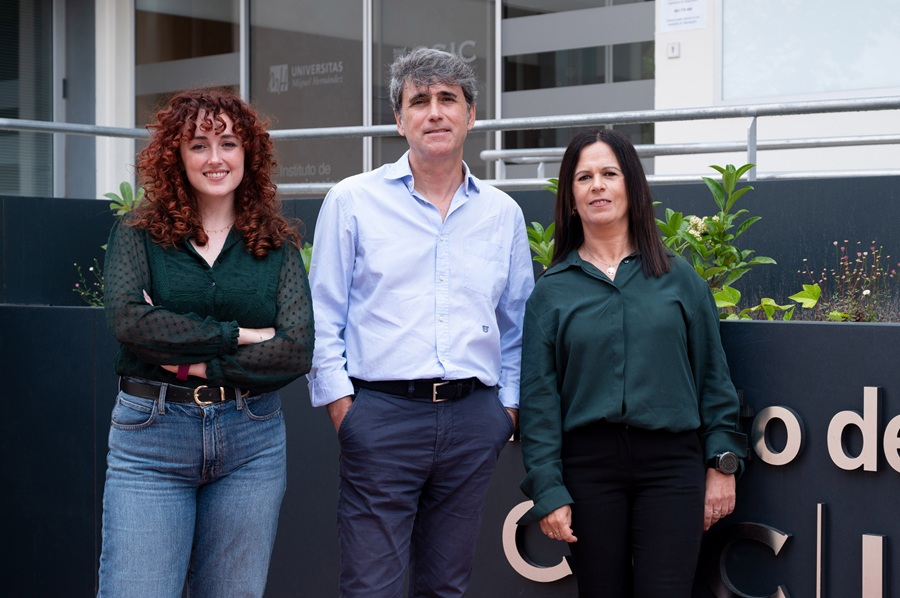
Photo: Researchers Adriana Gea, Javier Sáez Valero and María Salud García Ayllón at the Instituto de Neurociencias CSIC-UMH
A research team from the Fisabio Foundation in Elche has led a study that provides new insights into how Alzheimer’s disease develops. Researchers from the Institute of Neurosciences (IN), a joint center of Miguel Hernández University (UMH) and the Spanish National Research Council (CSIC), have also participated in the work. The findings, published in the journal Alzheimer’s Research & Therapy, help to better understand why the amyloid peptide accumulates in the brains of affected individuals. This molecule is the main component of amyloid plaques, abnormal protein deposits characteristic of the brains of people with Alzheimer’s disease.
The study identifies a decrease in ADAM10, a protein that, under normal conditions, helps prevent the accumulation of the amyloid peptide in the brain. According to the study’s findings, the reduction of this protein could promote the formation of amyloid plaques and thereby contribute to the development and progression of Alzheimer’s disease.
“This finding helps us better understand what is going wrong in the brains of patients and why the disease occurs”, explains María Salud García Ayllón, associate researcher at the Altered Molecular Mechanisms in Alzheimer’s Disease and Dementia Laboratory, which has led the study. “It also provides us with very valuable clues that could allow us to intervene earlier and more effectively”, the expert adds.
The study was carried out using brain tissue and cerebrospinal fluid samples from patients with Alzheimer’s disease and from healthy individuals of different age groups. The results indicate that the decrease in the ADAM10 protein is directly associated with the disease rather than with aging, reinforcing its importance as a potential therapeutic target.
One of the most relevant aspects of the study is that the detection of the decrease in this protein in cerebrospinal fluid opens up the possibility of using it as a new tool to improve the diagnosis of the disease. “Being able to measure these types of changes in an accessible way would allow us to move toward earlier and more accurate diagnoses”, points out the researcher.
Likewise, the results suggest new avenues for the development of treatments aimed at restoring this protective brain mechanism in which this protein is involved. “Our goal is for these advances to translate into real benefits for patients, improving their quality of life and offering new therapeutic options”, concludes the researcher.
The study was funded by the Fisabio Foundation, the Valencian Government, and the Carlos III Health Institute, and reinforces the commitment of public research to generating practical clinical knowledge applicable to patients and to improving public health.
Selective reduction of ADAM10 in brain and cerebrospinal fluid of Alzheimer’s disease patients. Gea-González, A., Valle-Pedroso, R., López-Font, I., Zetterberg, H., Blennow, K., Sáez-Valero, J. and García-Ayllón, M.S. Alzheimer’s Research & Therapy (2026) 18, 98
This work, conducted at the IN UMH-CSIC, involved PhD student Adriana Gea and researcher Mª Salud García Ayllón, both from Fisabio, in collaboration with UMH professor Javier Sáez Valero, researcher Inmaculada López Font, and Renata Valle Pedroso, a researcher at the Federal University of São Carlos (Brazil).
Source: Elche General Hospital Health Department / UMH Communication Service (comunicacion@umh.es)
The original press release is available in the attached file.