Español
The Institute for Neurosciences launches ‘Neuroscience Without Barriers’, an initiative to bring science outreach closer to diverse audiences
29 de May de 2026
The initiative ‘Neuroscience Without Barriers’, promoted by the Institute for Neurosciences (IN), a joint center of the Miguel Hernández University of Elche (UMH) and the Spanish National Research Council (CSIC), held yesterday the first in a series of outreach events aimed at bringing neuroscience research closer to diverse audiences through accessible and participatory activities. This first event was held for a group of people with disabilities supported by Fundación Adecco, who were accompanied throughout the visit by the organization's support professionals. During the visit, participants were able to explore different aspects of brain research and neuroscience in a practical and engaging way through adapted talks and workshops.
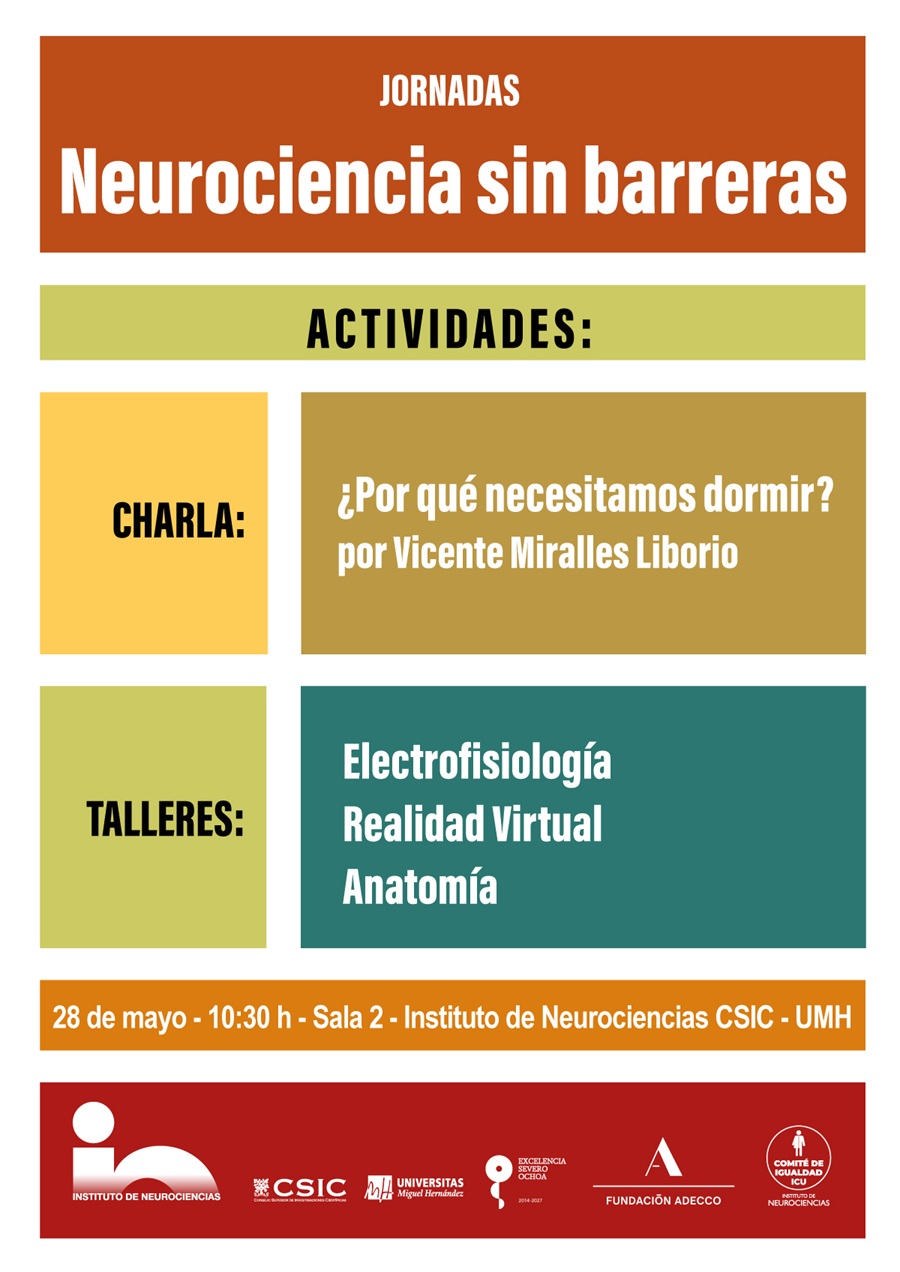
(Poster available in the attached document)
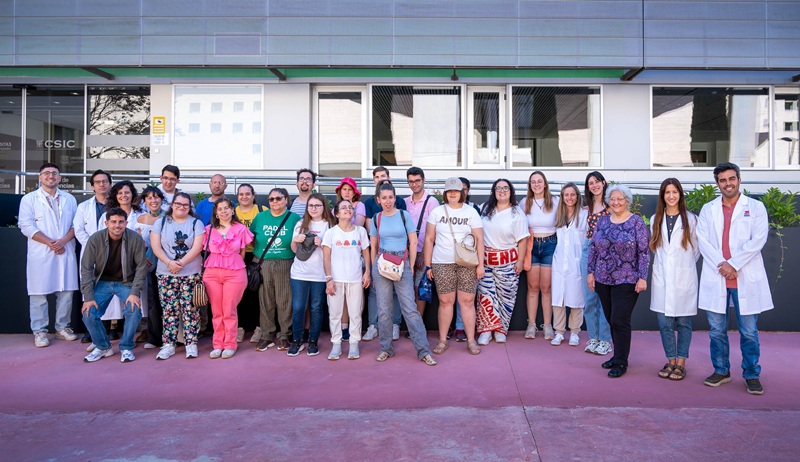
Participants and organizing teams of the first ‘Neuroscience Without Barriers’ event, held at the Institute of Neurosciences UMH-CSIC.
The program included the outreach talk “Why Do We Need Sleep?”, delivered by Vicente Miralles Liborio, a PhD student at the Ocular Neurobiology laboratory, which focused on explaining the importance of sleep for brain function and health. After the talk, attendees had the opportunity to explore some of the tools and techniques currently used in neuroscience through several adapted workshops. The event included an electrophysiology activity led by Anna Ollé Llado, a PhD student at the Ocular Neurobiology laboratory; a virtual reality experience coordinated by Encarni Marcos, researcher at the Plasticity of Brain Networks laboratory; and a human anatomy workshop developed by researchers Nicanor Morales and Pilar Madrigal from the Neurobiology of mental, neurodegenerative and neuro-oncological diseases laboratory.
With this initiative, the IN UMH-CSIC aims to continue expanding the social reach of its outreach activities and to foster spaces for interaction between scientific research and diverse audiences through accessible and participatory formats. “Science should be an open and shared space. Our goal is to continue working so that our activities reach more and more people, taking into account different realities, needs, and ways of engaging with scientific knowledge”, says Juana Gallar, director of the Institute for Neurosciences.
The event also proved to be a very positive experience both for the attendees and for the research and outreach staff involved in the activities. Juan Antonio Sánchez Alcañiz, coordinator of the communication and science outreach axis at the IN UMH-CSIC, highlighted the interest, participation, and welcoming atmosphere generated throughout the visit, and especially thanked Fundación Adecco for its collaboration and the support provided by its professionals, which was “essential for developing a truly participatory and enriching activity for everyone involved”.
In this regard, Laura Medina, coordinator of Plan Familia Levante at Fundación Adecco, highlighted the importance of carrying out this type of activity: “Creating spaces where science can be understood, experienced, and enjoyed contributes not only to learning, but also to fostering social participation, curiosity, and the well-being of people with disabilities. Undoubtedly, these kinds of initiatives promote the development of skills, confidence, and autonomy, which are key aspects for expanding opportunities for labour inclusion. This is precisely why our partnership with IN UMH-CSIC is so important: it allows us to bring the scientific world closer to the reality of people with disabilities and shows that, in an era defined by collaboration, joining forces is essential to generate real social impact”.
About Fundación Adecco
Fundación Adecco is a non-profit organization that works to promote the social and labour inclusion of people in vulnerable situations, especially people with disabilities, long-term unemployed individuals over the age of 45, women with sole family responsibilities, and people at risk of social exclusion. Through guidance, training, and support programmes, the foundation promotes initiatives aimed at fostering equal opportunities and active participation in different social and professional settings.
Source: Institute for Neurosciences UMH-CSIC (in.comunicacion@umh.es)