
 Español
Eduardo Fernández Ortuño, local finalist in the #HiloTesis competition
1 de June de 2026
A ferret, a mouse, a chicken, and a snake walk into a bar… This is how researcher Eduardo Fernández Ortuño begins his social media post. In an Instagram carousel, he explains how the brain develops during the embryonic stage and the differences that distinguish birds, reptiles, and mammals. His science communication adaptation of his doctoral research in the #HiloTesis format has been selected as a local finalist at Miguel Hernández University of Elche (UMH) in the sixth edition of the competition, organized by the Conference of Rectors of Spanish Universities (CRUE).
In his doctoral thesis, supervised by Víctor Borrell, researcher at the Institute for Neurosciences, a joint center of UMH and the Spanish National Research Council (CSIC); Eduardo Fernández investigates why the cerebral cortex of birds, reptiles, and different mammals initially develops in a very similar way during the early embryonic stages, but later follows different developmental paths in species with folded brains, such as humans. “A large part of the answer lies in the way the cortex generates neurons during development”, explains the researcher.
During embryonic development, different types of neural progenitor cells divide and produce new neurons, which in mammals migrate along radial glial fibers until they reach their final position in the cerebral cortex. However, this growth process does not occur in the same way across all species. While in mammals progenitor cells generate the large number of neurons that will form the neocortex, the development of this brain region is more limited in birds and reptiles.
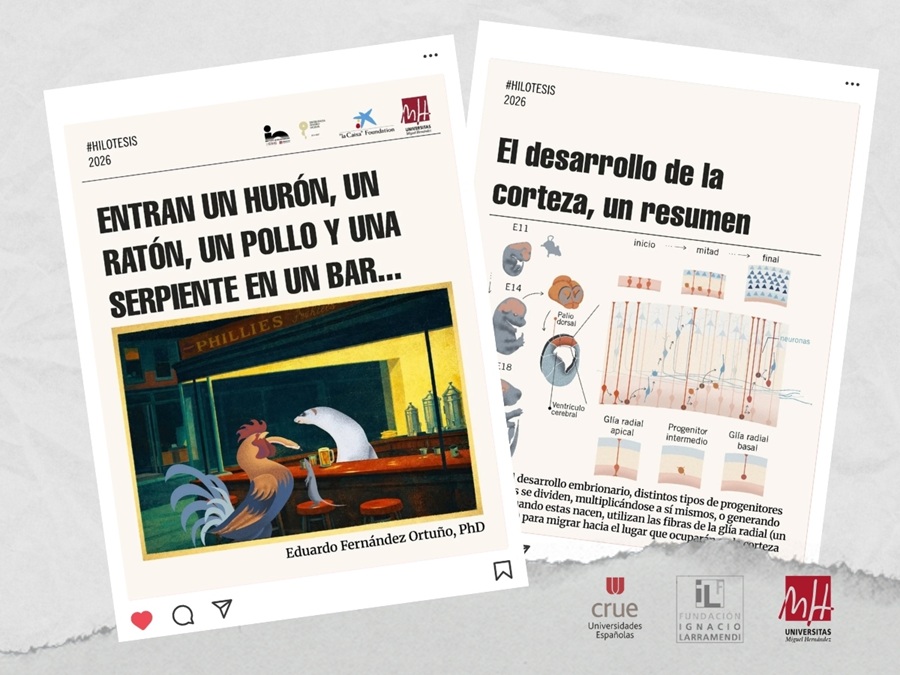
Images from the Instagram carousel through which Eduardo Fernández Ortuño participates in #ThesisThread. Source: UMH.
This growth is not uniform: while some regions expand considerably and form folds or gyri, others grow less and give rise to the characteristic grooves of the human brain. Furthermore, in mammalian species with larger brains, neocortical growth becomes so extensive that it eventually folds into the distinctive gyri and sulci observed in species such as ferrets and humans.
This brain folding is essential for proper brain organization, as alterations in the process can lead to severe neurological and cognitive disorders. Some rare diseases are associated with mutations that prevent the normal formation of these folds. For this reason, basic research is crucial for understanding these conditions and advancing toward future therapies. Comparisons with birds and reptiles may provide key insights into the specific properties of neural progenitor cells in mammals.
Eduardo Fernández Ortuño’s research is supported by the “la Caixa” Foundation, as well as by the Severo Ochoa Programme for Centres of Excellence in R&D and the Spanish Ministry of Science, Innovation and Universities.
#HiloTesis is an initiative promoted by CRUE and the Network for Science Outreach and Culture (RedDivulga). In the 2026 edition, more than 250 participants from Spanish universities took part. A jury will select the six best science communication entries among all finalists chosen by each university. The winning entries will receive a prize of €500 thanks to the support of the Ignacio Larramendi Foundation.
Source: UMH Communication Office (comunicacion@umh.es)
The original press release can be found in the attached file.