
 Español
Professor Sonia Garel receives the 12th Remedios Caro Almela Prize for Research in Developmental Neurobiology
24 de April de 2026
- Sonia Garel’s research has reshaped the paradigm of brain development by revealing the role of corridor cells and microglia in the formation of neuronal circuits.
- The Remedios Caro Almela Prize recognizes, every two years, scientific excellence in developmental neurobiology and is endowed with €25,000.
The award ceremony for the 12th Remedios Caro Almela Prize for Research in Developmental Neurobiology took place today in the Assembly Hall of the Institute for Neurosciences (IN), a joint center of the Miguel Hernández University of Elche (UMH) and the Spanish National Research Council (CSIC). The Rector of UMH, Juan José Ruiz, and the Director of the Institute for Neurosciences, Juana Gallar, presented the award to Sonia Garel, Professor at the Collège de France, who leads the Brain Development and Plasticity laboratory at the Institut de Biologie de l’École Normale Supérieure in Paris (IBENS).
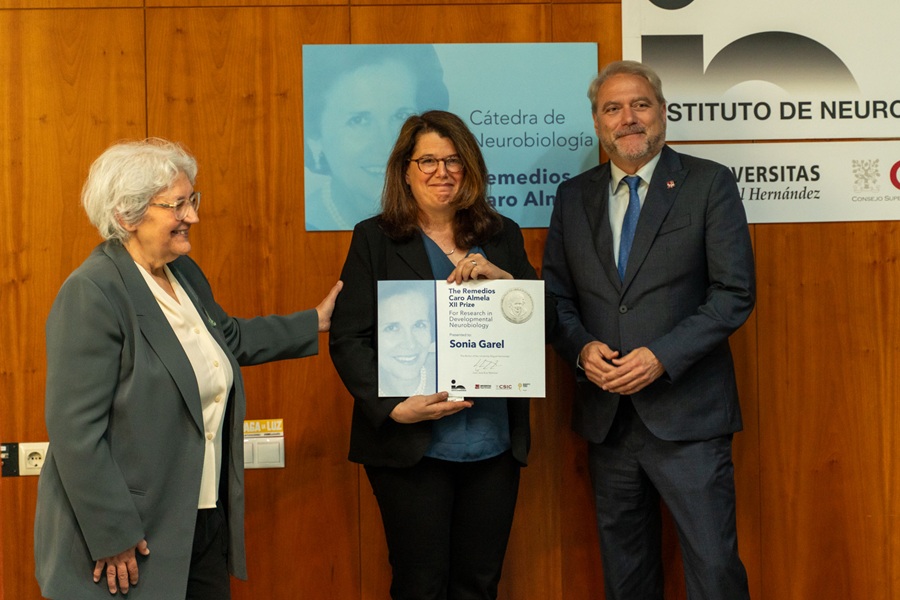
The Rector of UMH, Juan José Ruiz, and the Director of the IN UMH-CSIC, Juana Gallar, present the award to Professor Sonia Garel. Source: IN UMH-CSIC.
During the ceremony, remarks were also delivered by the Regional Director of Health of the Generalitat Valenciana in Alicante, Francisco J. Ponce Lorenzo, and the CSIC Vice President for Innovation and Knowledge Transfer, Ana Castro Morera. Following the reading of the jury’s decision, the awardee addressed the audience, emphasizing the collective nature of research: “This distinction reflects, above all, a shared effort built over years of work with students, collaborators, and colleagues. For me, research is a collective endeavor, grounded in the exchange of ideas and the joint construction of knowledge”.
A cellular choreography
Sonia Garel’s research focuses on understanding how the brain is built during development, a process that can be understood as a complex cellular choreography in which neurons, glial cells, and environmental signals interact with remarkable precision in space and time. Her work has helped transform the classical view of this process as a linear program, showing instead that it is a dynamic construction based on continuous interactions between cells, signals, and context.
Among her most influential contributions is the identification of the role of transient cell populations, such as the so-called corridor cells, which act as essential guides for axonal growth during the formation of brain circuits. These findings changed the way cortical development is understood by demonstrating that neuronal migration not only positions neurons but also actively participates in circuit organization by generating key signals at specific times and locations. Her work has also highlighted how early neuronal activity influences these processes, modulating neuronal movement, integration, and survival.
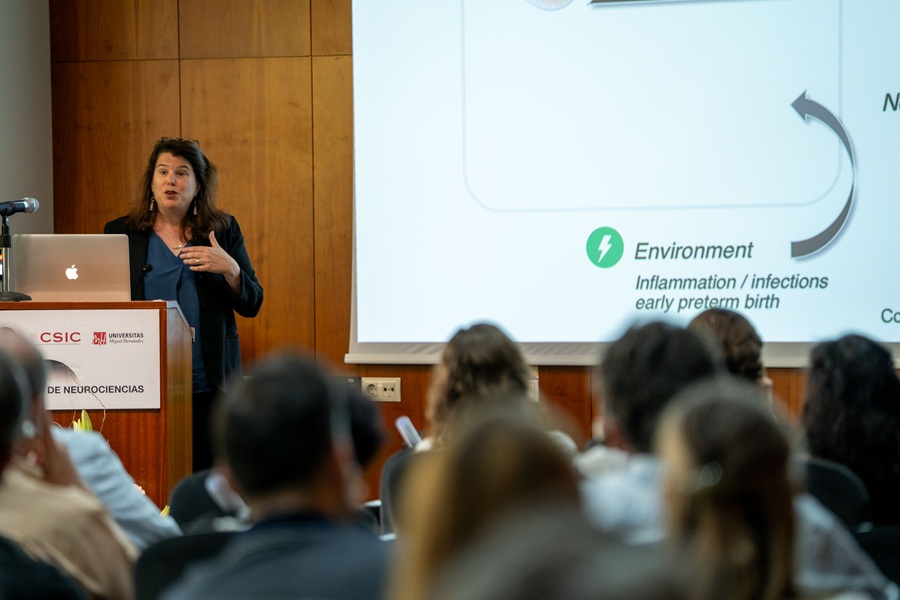
Professor Garel delivered the 12th Remedios Caro Almela Lecture, “Microglia in the early choreography of brain construction”, before the award ceremony. Source: IN UMH-CSIC.
Another central focus of her research has been the incorporation of microglia, the brain’s immune cells, into the study of neural development. Her team has shown that these cells do not act solely as sentinels, but as active participants in brain construction, regulating neuronal migration and network integration, as well as responding to external signals such as inflammation and the microbiota.
More recently, her work has revealed a protective role for microglia during brain morphogenesis, contributing to the preservation of tissue integrity under conditions of stress. Taken together, these findings provide a new framework for understanding how early interactions between cells and their environment influence brain function and vulnerability throughout life.
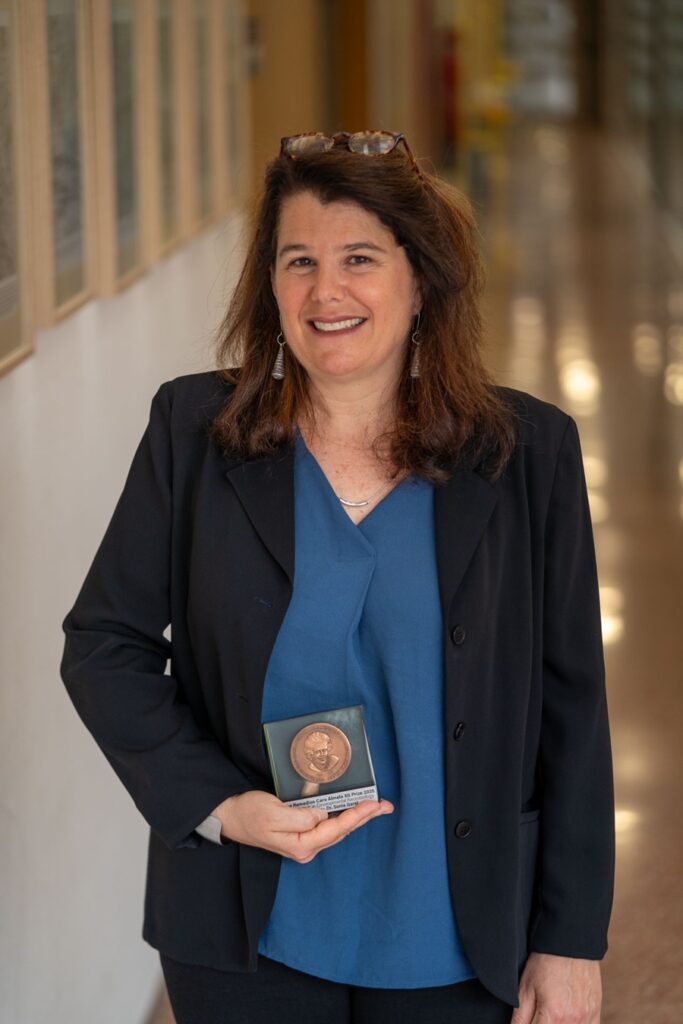
Professor Sonia Garel, awarded the 12th Remedios Caro Almela Award for Research in Developmental Neurobiology. Source: IN UMH-CSIC.
The aim of the Remedios Caro Almela Prize for Research in Developmental Neurobiology is to recognize the work of European researchers who have made particularly outstanding scientific contributions in this field and who are currently conducting cutting-edge research on the development of the nervous system. The biennial award is organized by the Institute for Neurociencias UMH-CSIC and the Miguel Hernández University of Elche, in collaboration with the Martínez-Caro family, and is endowed with €25,000.
Source: Institute for Neurociencias UMH-CSIC (in.comunicacion@umh.es)