
 Español
International Day of Women and Girls in Science, 11–20 Feb 2026
10 de February de 2026
The Institute for Neurosciences celebrates the International Day of Women and Girls in Science with outreach talks in schools across the province
The Institute for Neurosciences (IN), a joint centre of the Miguel Hernández University of Elche (UMH) and the Spanish National Research Council (CSIC), is once again taking part in the celebration of the International Day of Women and Girls in Science (11F) with an initiative aimed at school audiences across the province of Alicante. On this occasion, eight IN female researchers will visit different primary and secondary schools to deliver outreach talks, starting on 11 February and continuing throughout the following week.
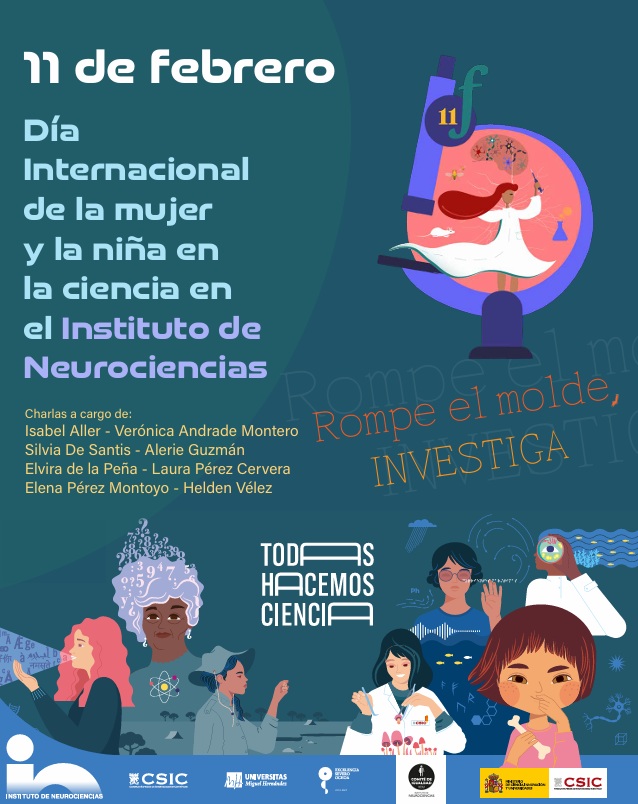
The talks are aimed at primary, lower secondary, and upper secondary school students, and address through different approaches the contribution of women to science throughout history, personal experiences in research careers, and various aspects of current neuroscience research. This initiative aims to bring science closer to the educational environment, provide accessible female role models, and foster scientific vocations among children.
Talks in schools
Nobel Prize in Science: 26 Women Do Not Tell the Whole Story
Alerie Guzmán de la Fuente, Principal Investigator of the Neuroimmunology of Oligodendroglia Laboratory, will deliver this talk at IES Cabo de la Huerta, aimed at lower and upper secondary school students. Drawing on the 26 women who have been awarded the Nobel Prize in scientific disciplines, the talk reflects on the historical role of women in science, how research practices have evolved, and how today’s women scientists are leading projects and transforming research.
How to Study Our Brain
Isabel Aller, researcher at the Synaptic Physiology Laboratory, will deliver this talk to students at CEIP San Blas. Using adapted audiovisual materials and relatable examples, she will explain what a neuron is, how neurons communicate with each other, and what changes occur in the brain when we study, sleep, or feel pain, introducing basic neuroscience concepts and highlighting the role of the mouse brain in research.
Neuroscientists Here and Now: What We Know About the Brain and What We Are Still Discovering
Silvia De Santis, Principal Investigator of the Translational Imaging Biomarkers Laboratory, will deliver this talk at CEIP El Faro. The activity focuses on women currently working in scientific research, in proximity to the students’ own environment, addressing recent discoveries in brain plasticity, memory, and learning, and highlighting that science is conducted here and now by real people.
Emotions: What Happens in Our Brain?
Helden Vélez, PhD student at the Cognition and Social Interactions Laboratory, will give a talk at CEIP Rajoletes (Sant Joan d’Alacant). Drawing on everyday emotions such as fear, joy, and sadness, the talk introduces, through an outreach approach, what happens in the brain when we feel, how our experiences shape these processes, and the neurobiological mechanisms underlying emotional responses.
A Neuroscientific Tragicomedy: Interneurons, Circuits, and Many Hours in the Lab
Elena Pérez Montoyo, researcher in the Development, Plasticity and Reprogramming of Sensory Circuits Laboratory, will deliver a talk at IES Haygón (San Vicente del Raspeig). Through a personal narrative, she will introduce students to scientific training and laboratory work, explaining her research on how the brain selects relevant information for memory and the role of interneurons in the hippocampus.
How I Ended Up Studying the Brain Without Planning It
Laura Pérez Cervera, researcher in the Translational Imaging Biomarkers Laboratory, will give a talk at IES Enric Valor (El Campello). Drawing on her own experience, she will share a non-linear career journey, showing how one can gradually enter neuroscience research and explaining what questions are currently being investigated in the field and how the brain is studied.
Teaching Driven by Curiosity and Research Leaves a Mark
Elvira de la Peña, co-leader of the Sensory Transduction and Nociception Laboratory, will deliver a talk at CEIP San Roque. She will combine her teaching and research experience to introduce students to the function of the cardiovascular system, highlighting the value of learning through curiosity and research as tools to leave a lasting impact on education.
Transporting Genes (Plasmids)
Verónica Andrade, technician in the Transcriptional and epigenetic mechanisms of neuronal plasticity Laboratory, will give a talk at IES Radio Exterior. She will explain what plasmids are and why they are fundamental tools in genetic engineering, highlighting their relevance in neuroscience for studying molecular and epigenetic interactions in neurons.
Throughout the days in which these activities take place, the Institute for Neurosciences will share content related to the talks and the participating women researchers through its social media channels, using the hashtags #TodasHacemosCiencia, #WinS, and #WomenInScience, linked to 11F and to the visibility of women in science.
Source: Institute for Neurosciences CSIC-UMH (in.comunicacion@umh.es)