
 Español

Scientist discover that the brain uses the same gene to form neurons before birth and regulate their connections after birth
26 de November de 2026
- Until now, it was unknown how this second process took place. A study led by King's College London, with the participation of the IBV-CSIC and the IN-CSIC-UMH, has shed light on the mechanisms involved.
- The researchers found in mice that this dual function of the gene enables neural circuits to adapt after birth and maintain an appropriate level of excitation to function properly.
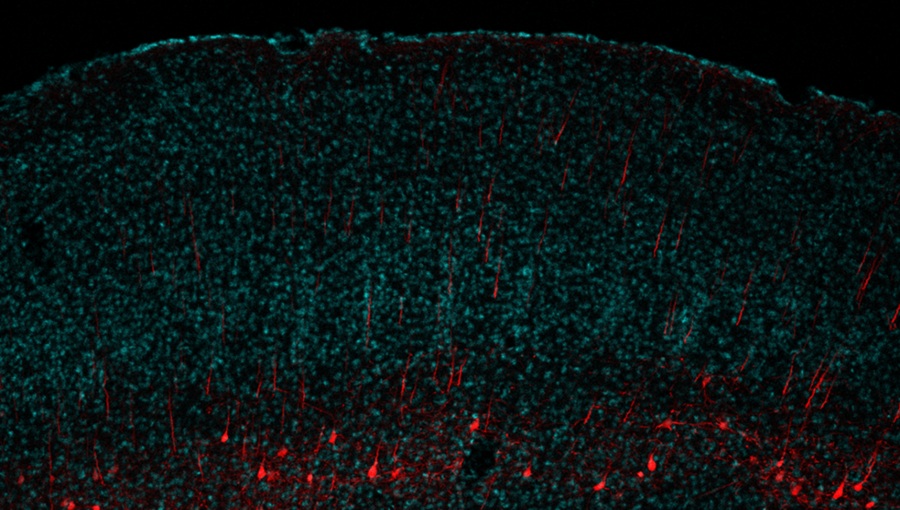
Microscopy image showing pyramidal neurons (in red) in layer 5 of the neocortex of a mouse brain. Credit: Beatriz Rico (King’s College).
An international team led by King’s College London, with the participation of the Spanish National Research Council (CSIC), has discovered that the gene Fezf2, which is essential for determining the function (identity) of certain neurons before birth, also regulates the connections they receive from other nerve cells after birth, depending on their activity. Until now, it was unknown how this adaptive process took place after birth. The findings show that the genetic mechanisms involved in neuron formation can also play a role later in fine-tuning brain circuits (plasticity).
This study, conducted in mice, has been published in the journal Nature Neuroscience and is led by the laboratory of Beatriz Rico, who was a CSIC researcher until a few years ago. The study also involved Nuria Flames’ group at the Institute of Biomedicine of Valencia (IBV-CSIC), and Ángel Barco’s group at the Institute for Neurosciences, a joint centre of the CSIC and Miguel Hernández University of Elche (UMH).
The study shows for the first time that this gene, called Fezf2, enables certain neurons in the cerebral cortex to adjust the inhibitory signals (braking signals) they receive according to their activity. It also helps explain how the brain coordinates the formation of its neural circuits to maintain the balance required for proper functioning.
The research has revealed a cascade of genes that recruit inhibitory connections in a specific type of cell: extratelencephalic pyramidal neurons (ET) in layer 5 of the mouse cerebral cortex. Through experiments in mice, the researchers found that increasing the electrical activity of these ET neurons also increases the levels of a protein called FEZF2, which promotes the formation of inhibitory connections from other neurons. These connections help reduce neuronal activity, thereby fine-tuning the circuit and maintaining an adaptive balance.
CSIC participation
The main novelty of the study is that this mechanism depends on a gene whose function was already known, but at an earlier stage of development. During embryonic brain development, Fezf2 helps determine the identity of certain neurons—that is, what type of cells they will become and what functions they will be able to perform.
What is new about the study is that, after birth, this same gene acquires an additional function in regulating the number of inhibitory connections these neurons receive in response to their activity. The researchers also identified another key component of the mechanism: Cdh22, a gene that produces a protein that facilitates the formation of connections between nerve cells. Its activity is regulated by Fezf2 and helps ensure that neurons receive the appropriate inhibitory signals.
To understand how neuronal electrical activity triggers these changes, the researchers analysed the mechanisms that regulate Fezf2 function. The collaboration with the Spanish teams was particularly important in this part of the study.
The group led by Nuria Flames at the Institute of Biomedicine of Valencia (IBV-CSIC) carried out experiments showing how certain proteins, whose activity is linked to neuronal activation, can stimulate the expression of the gene Fezf2.
“Our findings reveal that a gene initially involved in defining the identity of a neuronal subtype is later repurposed to control how neuronal activity fine-tunes connections between neurons,” explains Nuria Flames. “To the best of our knowledge, this is the first example of an identity transcription factor [a protein that regulates the activity of other genes] being regulated by neuronal activity. However, these studies could lead to similar findings in other contexts”, says the researcher, whose work focuses on how neuronal diversity is established using the model nematode C. elegans.
Meanwhile, Ángel Barco’s team, which leads the Transcriptional and Epigenetic Mechanisms of Neuronal Plasticity laboratory at the IN-CSIC-UMH, analysed data providing evidence that another protein, called FOS, binds to the DNA region responsible for regulating Fezf2 activity. These findings provide two complementary pieces of evidence that help explain how neuronal electrical activity can activate genetic mechanisms that modify neuronal connections.
“Fezf2 expression is increased by neuronal activity and depends on the action of FOS, a transcription factor that we investigate in my team,” explains Ángel Barco, whose research focuses on the mechanisms of brain adaptation. “Our contribution was to confirm, together with Nuria Flames, that the increase in Fezf2 expression depends on FOS and to identify the potential regulatory sequences”, he concludes.
These findings open up new avenues of research to determine whether other types of neurons use similar mechanisms during brain development and maturation.
Source: CSIC Valencian Community / CSIC Communications (comunicacion@csic.es)
The original press release is available in the attached document (Spanish).
Artículo: Kroon, T., Sanalidou, S., Maeso, P., Yang, H., Garces, T., Ahmed, N., Alis, R., Dominguez-Canterla, Y., Niñerola, S., Dunville, K., del Blanco, B., Barco, A., Flames, N. & Rico, B. (2026). The identity gene Fezf2 is repurposed postnatally to specify inhibitory input in an activity-dependent manner. Nature Neuroscience.
DOI: 10.1038/s41593-026-02515-67