
 Español
Science and Technology Week at the IN CSIC-UMH, nov-dec 2026
23 de November de 2026
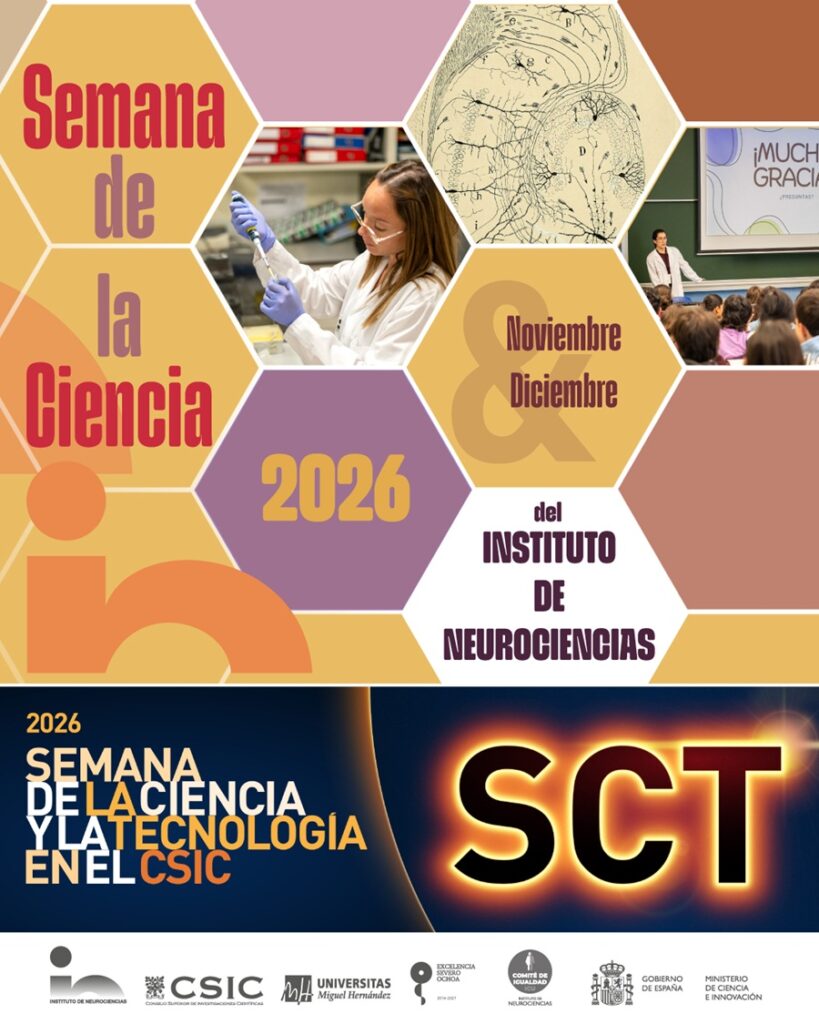
The Institute for Neuroscience (IN), a joint centre of the Spanish National Research Council (CSIC) and Miguel Hernández University of Elche (UMH), is once again taking part in Science and Technology Week. Throughout November and December, several researchers will visit secondary schools across the province of Alicante to give outreach talks about the research carried out at the IN, aimed at high school students.
Circuits in Transformation: Brain’s Plasticity
Researcher Elena Pérez Montoyo, from the Development, Plasticity and Reprogramming of Sensory Circuits laboratory, will share her experience in the field of neuroscience and the path that led her to investigate the brain’s remarkable ability to change and adapt throughout life. How do neural connections change, and what role do our experiences play in this process? Through the study of brain plasticity, she will explore how memories are formed, how sensory experiences influence the development and maturation of neural circuits, and what happens when sensory input is deprived.
What Am I Feeling? Discovering the Secrets of the Nervous System
Researcher Sara López Vázquez, from the Sensory Transduction and Nociception laboratory, will explain how the nervous system works and how it allows us to perceive sensations such as cold, heat, tickling, and pain. When we get injured, our nerves send a warning signal to the brain to alert us that something is wrong. But what happens when that alarm keeps ringing even after the wound has healed? Through this question, she will explore why pain, despite its protective function, can sometimes become a persistent problem.
Can We Live Without Pain?
Researcher Eva María Villalba Riquelme, also from the Sensory Transduction and Nociception laboratory, will highlight the importance of pain as a protective mechanism for our bodies. What would happen if we could not feel pain? And what if, on the contrary, it never went away? Through examples of people who cannot feel pain and those who suffer from chronic pain, she will explain how pain arises, what happens when it stops serving its protective function, and how some of the most common treatments work. She will also introduce current research in pain neuroscience and the strategies being developed to better understand and address pain.
Can Viruses Help Us Understand the Brain?
Researcher Cristina García Frigola, head of the Neurotropic Vectors Service, will explain how viruses, beyond their association with disease, can become valuable tools for brain research. Students will learn how scientists can study connections between neurons, control neuronal activity using light (optogenetics), and develop new gene therapy strategies using viral vectors.
The Sleep of Butterflies and Alzheimer's Disease
Researcher José Vicente Sánchez Mut, head of the Functional Epi-Genomics of Aging and Alzheimer’s Disease laboratory, will explain why sleep is much more than simply resting. During sleep, the brain performs essential functions for memory and learning, clears waste products, and strengthens connections between neurons, helping to maintain brain health. However, these mechanisms can deteriorate with ageing. Could we intervene in these processes to prevent or slow down diseases such as Alzheimer's?
Memory of Time: The Science of Ageing and Longevity
In a second presentation, José Vicente Sánchez Mut will explore ageing as a biological process that gradually transforms our cells over time. In recent years, scientific research has made significant progress in understanding the molecular mechanisms that drive this process. These advances open up new possibilities for intervening in ageing and raise an exciting prospect that once seemed difficult to imagine: delaying or even reversing some of its effects to promote a longer, healthier life.
The AI Between Our Ears: How Artificial Intelligence Works and What It Has to Do with Our Brain
María Sánchez Carcelén, research technician in the Molecular Mechanisms of Neuronal Identity research line, will explain how artificial neural networks and language models work, and how they relate to the neural networks in our brain. Through hands-on activities, students will have the opportunity to experience how these systems learn and discover some of their applications in scientific research, such as genetic data analysis and the search for new antibiotics. The talk will conclude with a discussion on the use of artificial intelligence in everyday life and the importance of making the most of its potential critically and responsibly.
Source: Institute for Neurosciences CSIC-UMH (in.comunicacion@umh.es)