
 Español
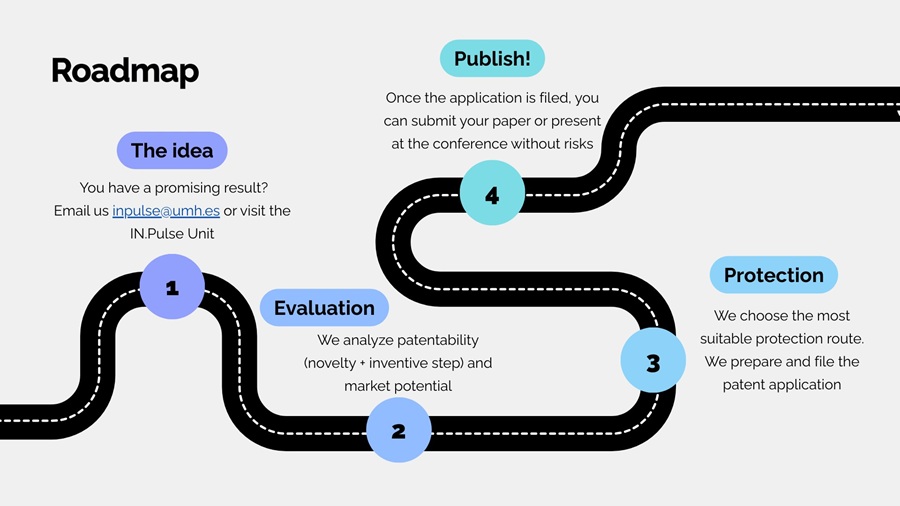
As a joint CSIC-UMH center, official protection is processed according to your affiliation. IN.Pulse centralizes and simplifies the entire process:
- Preliminary analysis: We prepare patentability reports (non-binding) using global databases (Lens, Linknovate, EspaceNet).
- Technical support: We assist you with the technical documentation and official forms.
- Direct communication: We coordinate communication with the relevant unit (VATC-CSIC or OTRI-UMH) based on the research staff’s affiliation.
Practical guide to Industrial & Intellectual Property for IN researchers
Novelty Requirement:
If you have a result with potential clinical or commercial use, it is necessary to consult its patentability before disclosure. Any public dissemination (poster, abstract, conference, or even a tweet) breaks novelty and makes it impossible to patent the invention later. Contact us before submitting your manuscript!
What can be protected?
 1. New Therapies:
- New molecules, second medical uses, combinations, new therapies.
2. Diagnostic Methods:
- Biomarkers, detection kits, imaging methods.
3. Research Tools:
- Devices, animal models, novel protocols.
4. Software & AI:
- Data analysis, AI code, databases (Copyright).
MYTH BUSTERS
Absolutely not. The procedure for protecting the intellectual property rights (IPR) of research results must begin before publication. You should contact us before submitting your manuscript to the journal (preferably). The entire process typically takes 2-3 months and consists of the following steps:
1. The technology or result will be included in a patentability application for CSIC or UMH.
2. The institutions will consider requesting an external patentability report.
3. If the institutions decide to do so, a patent or utility model application will be prepared with an external intellectual property office.
All costs arising from protecting the intellectual property of a technology or result are covered by the applicant entities, CSIC or UMH, depending on the affiliation of the researchers inventors.
The patent holders are the applicant entities (CSIC or UMH), and the researchers are the inventors. The patent protects the legal rights of inventors and entities in the event of commercial exploitation of the patent, ensuring that both recognition and economic benefits are shared.
No, there are no restrictions on using the information contained in a patent, whether your own or that of third parties, for research. Patents are public in their entirety.
 Contact us: inpulse@umh.es