Español
Interhemispheric CA1 projections to the subiculum support spatial cognition and are affected in a mouse model of the 22q11.2 deletion syndrome.
A study by the Institute for Neurosciences identifies a key brain circuit for spatial memory
• The study, published in Cell Reports, describes how a connection between the hippocampal hemispheres is essential for spatial navigation and memory-based decision-making.
• The results show that this connection is altered in a genetic disease model associated with schizophrenia, which could help to understand the origin of cognitive deficits.
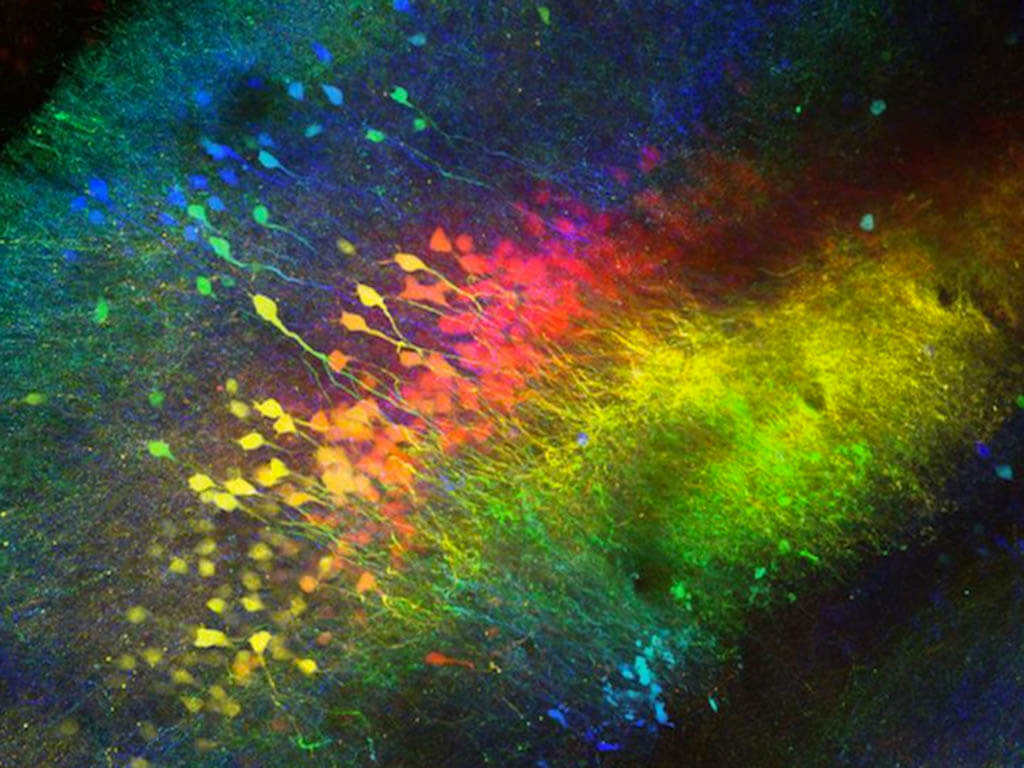
Photo: Researchers Cristina García Frigola, Félix Leroy, and Helden Vélez at the Institute for Neurosciences. Source: IN CSIC-UMH
A team led by the Institute for Neurosciences (IN), a joint center of the Spanish National Research Council (CSIC) and Miguel Hernández University of Elche (UMH), has identified a brain circuit essential for spatial memory. The study, published in Cell Reports, describes for the first time a connection between the two hippocampal hemispheres, in which neurons in the CA1 region of the right hemisphere send projections to the left hemisphere, specifically to the subiculum. The results show that this communication is necessary for navigation and remembering locations. Moreover, the study reveals that this circuit is altered in mice carrying a genetic mutation associated with schizophrenia.
“We knew that the hippocampus is key for memory, but we did not fully understand how its two hemispheres communicate. In this work, we identified a specific pathway and demonstrated that it is necessary for fundamental cognitive functions”, explains Felix Leroy, the principal investigator of the study and director of the Cognition and Social Interactions Laboratory at the Institute for Neurosciences.
A “Bridge” Between Hemispheres for Memory
The brain is divided into two hemispheres that process information in a partially specialized manner, yet they need to coordinate constantly. However, the specific connections that enable this communication in regions involved in memory, such as the hippocampus, are largely unknown.
In this work, the team identified one of these connections: a neuronal projection linking the CA1 region of the right hemisphere with the subiculum of the left hemisphere. To do this, the researchers used neuronal tracing techniques that allow them to follow the path of connections between neurons. “This circuit acts as a bridge between the two regions and enables the integration of information needed to navigate and remember the locations of things”, says Noelia Sofía de León Reyes, the first author of the study.
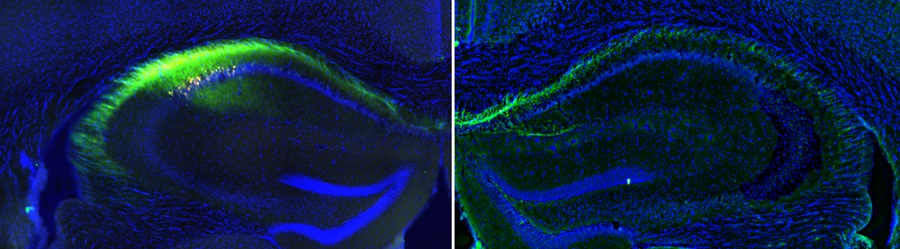
Microscopy image of the mouse hippocampi showing, in green, neuronal connections that act as a “bridge” between both hemispheres. These projections originate from neurons in the right CA1 region and reach equivalent areas on the opposite side, including the left subiculum. Source: IN CSIC-UMH.
To test the function of this circuit, the researchers used optogenetic tools, which allow the activity of specific neurons to be controlled with light. In this way, they were able to selectively block this connection in mice and observe its effects on behavior.
The results show that when this interhemispheric communication is disrupted, mice have difficulty remembering the location of objects and making decisions in tasks that require spatial memory. However, other functions, such as anxiety or object recognition, remain intact. “This indicates that this connection is not merely structural, but has a very specific role in spatial memory”, adds Leroy.
The team also studied this connection in a mouse model carrying a genetic alteration equivalent to the 22q11.2 deletion, a human condition that significantly increases the risk of developing schizophrenia and other neuropsychiatric disorders. In these animals, the researchers observed both spatial memory deficits and a reduction in interhemispheric hippocampal connections. Additionally, although the alteration is present in both sexes, males showed more pronounced deficits in some tests.
“We observed that when this circuit is altered, the ability to navigate and remember is also affected. This suggests that interhemispheric disconnection could contribute to cognitive problems in psychiatric disorders”, explains De León Reyes. The results provide a new piece of the puzzle for understanding how the brain integrates information between hemispheres and how its disruption can lead to cognitive deficits.
Additionally, the authors note that this finding could have long-term clinical implications. “These types of connections could be studied in humans using neuroimaging techniques, such as tractography, combined with cognitive tests”, notes Leroy. “In the long term, this could contribute to the development of new strategies for detecting brain alterations associated with disorders such as schizophrenia”.
The work combines different experimental approaches in mice to identify and analyze this brain circuit. The study involved collaboration with the laboratory of Marta Nieto from the Spanish National Center for Biotechnology (CNB-CSIC). While doing her PhD in the Nieto’s lab, Noelia Sofía de León Reyes began working on hippocampal interhemispheric connections and collected preliminary results. The study also involved Joseph A. Gogos from Columbia University (United States) who created the Df16(A) mouse model of 22q11 microdeletion, and incorporated the use of viral tools for manipulating neuronal circuit analysis with the participation of IN CSIC-UMH expert Cristina García Frigola.
This work was possible thanks to funding from the European Research Council (ERC) under the Horizon 2020 research and innovation program of the European Union, the Spanish State Research Agency – Ministry of Science, Innovation and Universities through the Severo Ochoa Program for Centers of Excellence, the Generalitat Valenciana, the “la Caixa” Foundation, the Severo Ochoa Foundation, and National Institute of Mental Health (NIMH) of the United States. This research is part of the MotivatedBehaviors project (H2020-ERC-STG/0784, no. 949652), which aims to study the role of the lateral septum in regulating motivated behaviors to reveal changes that occur in disorders associated with deficits in social behavior.
Source: Institute for Neurosciences CSIC-UMH (in.comunicacion@umh.es)