Español
Inhibitory tone in the dentate gyrus dynamically prioritizes memory flexibility or stability by tuning a sensitivity-consistency continuum.
Study by the Institute for Neurosciences CSIC-UMH reveals how the brain balances memory flexibility and stability
• Reducing inhibition in a region of the hippocampus improves the ability to distinguish between similar experiences, but increases vulnerability to interference as the amount of information to be remembered grows.
• A computational model has enabled researchers to identify this balance and predict that the optimal level of inhibition depends on memory load.
(Photo: From left to right: researchers Encarni Marcos, Santiago Canals, and Elena Pérez Montoyo. Credit: IN CSIC-UMH.)
A team from the Plasticity of Brain Networks laboratory at the Institute for Neurosciences (IN), a joint centre of the Spanish National Research Council (CSIC) and the University Miguel Hernández of Elche (UMH), has identified a mechanism that allows the brain to adjust the balance between two seemingly competing needs during memory formation: incorporating new details while maintaining representations that are sufficiently consistent to avoid confusing one experience with another. The study, published in the journal PLOS Biology, shows that the activity of inhibitory interneurons in the dentate gyrus, a region of the hippocampus, determines the extent to which the system is sensitive to small differences between similar experiences or, conversely, able to preserve stable representations.
Memory is not simply about storing a copy of every experience. For memory to be useful, the brain must be able to incorporate new information without every small change generating a completely different memory. For example, we need to recognise a place we visit regularly even if it has changed, while also being able to distinguish between two experiences when the differences between them are meaningful. This tension between sensitivity to change and memory consistency is the focus of this study. “Memory is not a static repository of information, but a living and adaptive process,” explains Santiago Canals, the researcher who co-led the study.
To investigate this mechanism, the researchers focused on the hippocampus, a brain region that is essential for the formation of new memories, and on one of its structures, the dentate gyrus. In this region, certain neurons inhibit the activity of other cells in the circuit, helping to regulate how new experiences are incorporated. The team experimentally modified this inhibitory activity in mice during memory encoding, that is, when information is processed to form a memory.
The researchers assessed the consequences of this manipulation using tasks in which the mice had to detect small changes in their environment. These animals have a natural preference for novelty, so their behaviour can reveal whether they remember a previous experience and whether they can detect differences from it.
The results showed that reducing inhibition increased sensitivity: when the change in an object’s position was very small, mice with lower inhibition were better able to detect it than control animals. Conversely, increasing inhibitory activity made the system less sensitive to these differences and generated representations that were more resistant to change.
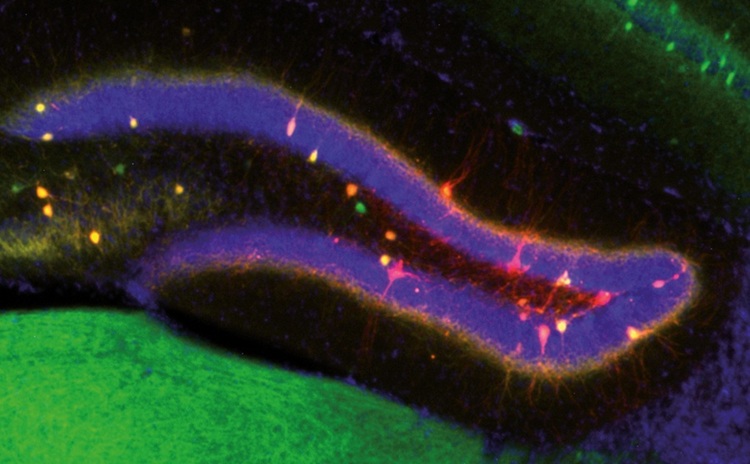
Image of the dentate gyrus of a mouse hippocampus. Green cells correspond to a type of inhibitory neuron, while red cells are those whose activity has been experimentally modified. Yellow cells show the overlap between the two signals. Source: IN CSIC-UMH.
“By manipulating inhibition, we were able to modify how the mice performed the task. At lower-than-usual levels, their behaviour was more consistent with better memory retrieval and more detailed recall”, says Encarni Marcos, head of the Neural Mechanisms of Behavior research line at the IN CSIC-UMH and co-leader of the study.
A computational model to identify the balance
To understand why lower levels of inhibition are not always beneficial, the team developed a computational model that provides a simplified representation of how memory representations are formed and retrieved in the brain. The model allows researchers to vary the level of inhibition and explore how it affects the system’s ability to distinguish between similar experiences while maintaining consistent representations.
The model predicted that there is no single optimal level for all situations: with a low memory load, lower inhibitory activity may favour discrimination, whereas higher activity helps maintain more consistent representations as the amount of information increases.
These predictions were subsequently tested in animals using a task in which the mice had to learn associations between objects, locations and different environments. “By combining experimental and computational tools, we have identified a balance point in memory formation that helps us understand when this system, which must be flexible to be useful, updates with new information and when it maintains greater consistency”, explains Canals.
The team also found that this effect occurs specifically during encoding, that is, when the initial representation of an experience is formed. The mechanism identified therefore plays a role in the initial construction of the representation, rather than in its subsequent stabilization or retrieval.
A dynamic balance
The results suggest that inhibitory circuits in the dentate gyrus help place the hippocampus in different functional states: greater sensitivity facilitates the incorporation of changes and the discrimination of similar experiences, whereas greater consistency protects representations from interference. The study suggests that this balance can be adjusted according to the demands of the task.
“What we interpret from these results is that there is a mechanism that dynamically adjusts the mode of operation by using inhibition,” explains Marcos. The researchers stress, however, that the study has not identified which signals control this adjustment under natural conditions. Determining which mechanisms regulate inhibitory activity and when this shift in state occurs will be the subject of future research.
This work was possible thanks to the funding from the Spanish State Research Agency; the Ministry of Science, Innovation and Universities; the Severo Ochoa Programme for Centres of Excellence; the European Union’s Next Generation funds; and the Generalitat Valenciana.
Source: Institute for Neurosciences CSIC-UMH (in.comunicacion@umh.es)