
 Español
Lines of investigation
Emerging Line of the group: «Plasticity of Brain Networks»
Like other cognitive processes, memory emerges from interactions across multiple spatial and temporal scales and hierarchical levels, from molecules, genes, neurons, and cellular microcircuits to large-scale neuronal networks. Despite decades of progress, dominant frameworks of memory formation remain largely corticocentric, emphasizing hippocampal-cortical interactions as the main substrate of episodic memory. While these models have explained key aspects of memory processing, they have also constrained system-level inquiry, leaving the contribution of subcortical systems comparatively underexplored. In particular, little attention has been devoted to how mnemonic information is processed and exchanged through circuit interactions between hippocampal-cortical systems and brainstem nuclei. This conceptual asymmetry is not merely historical, but continues to shape experimental design, theoretical interpretation, and the broader direction of the field.
Our research line investigates systems-level neural mechanisms underlying memory, focusing on how sleep and arousal contribute to memory formation and maintenance. We study how these processes emerge from the coordinated activity of brainstem and thalamic nuclei, the hippocampus, and the neocortex. To this end, we combine in vivo electrophysiology, computational modelling, optogenetics, physiological circuit mapping approaches, wide-field mesoscopic imaging, and behavioural paradigms in rodents.
In parallel, we investigate how large-scale neural activity interacts with autonomic and internal-state body physiology in both rodents and humans, with the goal of identifying mechanisms with translational relevance for neurocognitive and stress-related disorders
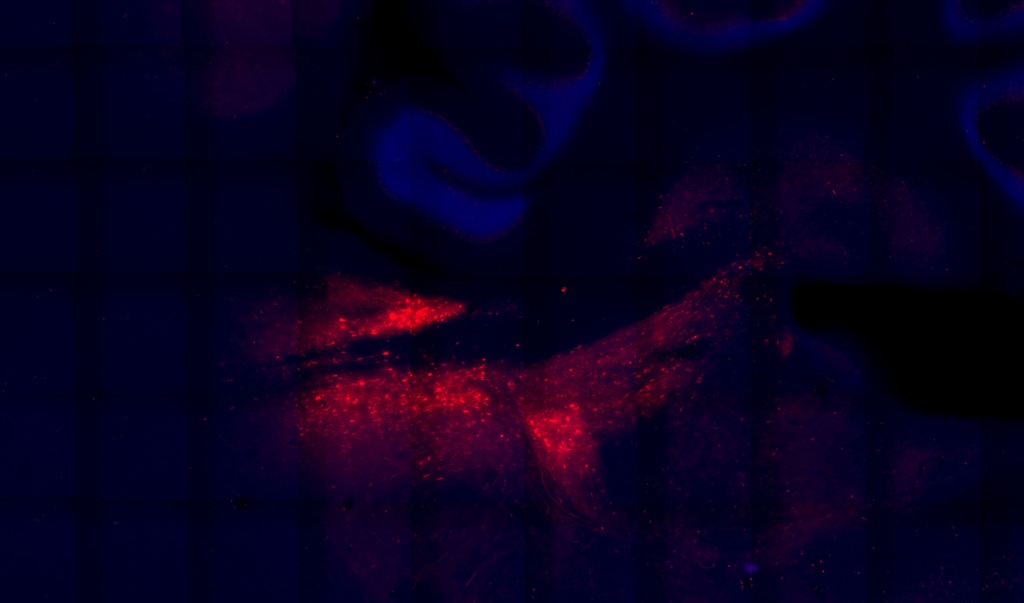
Photo: Jago Wallenschus & Sofia Taveira (ISTA)
Representative Publications
- Exercise acutely modulates hippocampal-neocortical ripple dynamics. Ramirez-Cardenas, A., Ramirez-Villegas, J.F., Kovach, C., Cole, R., Grossbach, A., Gander, P.E., Kawasaki, H., Greenlee, J.D., Howard, M.A., Banks, M. & Voss, M.W. Brain Communications. 2026 8(2): fcag041 https://doi.org/10.1371/journal.pcbi.1010983
- Uncovering the organization of neural circuits with generalized phase locking analysis. Safavi, S., Panagiotaropoulos, T.I., Kapoor, V., Ramirez-Villegas, J.F., Logothetis, N.K. & Besserve, M. PLOS Computational Biology. 2023 202219(4): e1010983 https://doi.org/10.1371/journal.pcbi.1010983
- Editorial: Neuromodulatory ascending systems: Their influence at the microscopic and macroscopic levels. Gambino, G., Bhik-Ghanie, R., Giglia, G., Puig, M.V., Ramirez-Villegas, J.F. & Zaldivar, D. Frontiers in Neural Circuits. 2022 16(1028154): 1-3 https://doi.org/10.3389/fncir.2022.1028154
- Coupling of hippocampal theta and ripples with pontogeniculooccipital waves. Ramirez-Villegas, J.F., Besserve, M., Murayama, Y., Evrard, H.C., Oeltermann, A. & Logothetis, N.K. Nature. 2021 589(7840): 96-102 https://doi.org/10.1038/s41586-020-2914-4
- Dissecting the frequency-dependent network mechanisms of in vivo hippocampal sharp wave-ripples. Ramirez-Villegas, J.F., Willeke, K.F., Logothetis, N.K. & Besserve, M. Neuron. 2018 100(5), 1224-1240 https://doi.org/10.1016/j.neuron.2018.09.041
- Diversity of sharp wave-ripple complexes reveals differentiated brain-wide dynamical events. Ramirez-Villegas, J.F., Logothetis, N.K. & Besserve, M. Proceedings of the National Academy of Sciences of the USA (PNAS). 2015 112(46): E6379-E6387 https://doi.org/10.1073/pnas.1518257112
- A saliency-based bottom-up visual attention model for dynamic scenes analysis. Ramirez-Moreno, D.F., Schwartz, O. & Ramirez-Villegas, J.F. Biological Cybernetics. 2013 107(2): 141-160 https://doi.org/10.1007/s00422-012-0542-2
- Color coding in the cortex: A modified approach to bottom-up visual attention. Ramirez-Villegas, J.F. & Ramirez-Moreno, D.F. Biological Cybernetics 2013 107(1): 39-47 https://doi.org/10.1007/s00422-012-0522-6
- Wavelet packet energy, Tsallis entropy and statistical parameterization for support vector-based and neural-based classification of mammographic regions. Ramirez-Villegas, J.F. & Ramirez-Moreno, D.F. Neurocomputing. 2012 77(1): 82-100 https://doi.org/10.1016/j.neucom.2011.08.015
- Heart rate variability dynamics for the prognosis of cardiovascular risk. Ramirez-Villegas J.F., Lam-Espinosa, E., Ramirez-Moreno, D.F., Calvo-Echeverry, P.C. & Agredo-Rodriguez, W. PLoS ONE. 2011 6(2): e17060 https://doi.org/10.1371/journal.pone.0017060

- Exercise acutely modulates hippocampal-neocortical ripple dynamics. Ramirez-Cardenas, A., Ramirez-Villegas, J.F., Kovach, C., Cole, R., Grossbach, A., Gander, P.E., Kawasaki, H., Greenlee, J.D., Howard, M.A., Banks, M. & Voss, M.W. Brain Communications. 2026 8(2): fcag041 https://doi.org/10.1371/journal.pcbi.1010983
- Uncovering the organization of neural circuits with generalized phase locking analysis. Safavi, S., Panagiotaropoulos, T.I., Kapoor, V., Ramirez-Villegas, J.F., Logothetis, N.K. & Besserve, M. PLOS Computational Biology. 2023 202219(4): e1010983 https://doi.org/10.1371/journal.pcbi.1010983
- Editorial: Neuromodulatory ascending systems: Their influence at the microscopic and macroscopic levels. Gambino, G., Bhik-Ghanie, R., Giglia, G., Puig, M.V., Ramirez-Villegas, J.F. & Zaldivar, D. Frontiers in Neural Circuits. 2022 16(1028154): 1-3 https://doi.org/10.3389/fncir.2022.1028154
- Coupling of hippocampal theta and ripples with pontogeniculooccipital waves. Ramirez-Villegas, J.F., Besserve, M., Murayama, Y., Evrard, H.C., Oeltermann, A. & Logothetis, N.K. Nature. 2021 589(7840): 96-102 https://doi.org/10.1038/s41586-020-2914-4
- Dissecting the frequency-dependent network mechanisms of in vivo hippocampal sharp wave-ripples. Ramirez-Villegas, J.F., Willeke, K.F., Logothetis, N.K. & Besserve, M. Neuron. 2018 100(5), 1224-1240 https://doi.org/10.1016/j.neuron.2018.09.041
- Diversity of sharp wave-ripple complexes reveals differentiated brain-wide dynamical events. Ramirez-Villegas, J.F., Logothetis, N.K. & Besserve, M. Proceedings of the National Academy of Sciences of the USA (PNAS). 2015 112(46): E6379-E6387 https://doi.org/10.1073/pnas.1518257112
- A saliency-based bottom-up visual attention model for dynamic scenes analysis. Ramirez-Moreno, D.F., Schwartz, O. & Ramirez-Villegas, J.F. Biological Cybernetics. 2013 107(2): 141-160 https://doi.org/10.1007/s00422-012-0542-2
- Color coding in the cortex: A modified approach to bottom-up visual attention. Ramirez-Villegas, J.F. & Ramirez-Moreno, D.F. Biological Cybernetics 2013 107(1): 39-47 https://doi.org/10.1007/s00422-012-0522-6
- Wavelet packet energy, Tsallis entropy and statistical parameterization for support vector-based and neural-based classification of mammographic regions. Ramirez-Villegas, J.F. & Ramirez-Moreno, D.F. Neurocomputing. 2012 77(1): 82-100 https://doi.org/10.1016/j.neucom.2011.08.015
- Heart rate variability dynamics for the prognosis of cardiovascular risk. Ramirez-Villegas J.F., Lam-Espinosa, E., Ramirez-Moreno, D.F., Calvo-Echeverry, P.C. & Agredo-Rodriguez, W. PLoS ONE. 2011 6(2): e17060 https://doi.org/10.1371/journal.pone.0017060
- Una implementación computacional de un modelo de atención visual Bottom-up aplicado a escenas naturales. Ramirez-Moreno, D.F. & Ramirez-Villegas, J.F. Revista de Ingeniería. 2011 35(2): 6-11 https://doi.org/10.16924/revinge.35.1