Español
Lines of investigation
Emerging Line of the group: “Cell Plasticity in Development and Disease”
Phenotypes are not solely determined by cell-intrinsic genetic and epigenetic programs. Instead, they are constantly influenced by interactions with the surrounding ecosystem.
Cell-Ecosystem interactions are dynamic and are key to coordinating tissue-level responses and adaptation to environmental changes and pathological stressors, thereby safeguarding integrity and function. Importantly, unresolved injury or oncogenic insults reprogram those interactions, shifting them toward adverse degenerative or pro-tumor states.
Our line of research extends this framework by placing Neuro-Ecosystem interactions at the center of homeostasis, injury, and oncogenic responses. We are seeking to elucidate how the nervous system, as an integral component of tissue ecosystems, governs the balance between health and disease in peripheral tissues and the central nervous system (CNS). In peripheral tissues (using epithelial tissues as a model), we focus on neuro-epithelial interactions in homeostasis and cancer, asking how the PNS orchestrates epithelial integrity and plasticity, and how neuron-epithelial ecosystems are rewired during cancer initiation, progression, and therapy response. In the CNS, we extend our framework to explore how Neuron-Ecosystem interactions underlie the heterogeneity and complexity of injury responses and cancer, driving phenotypic plasticity and the shift toward degenerative or pro-cancer states.
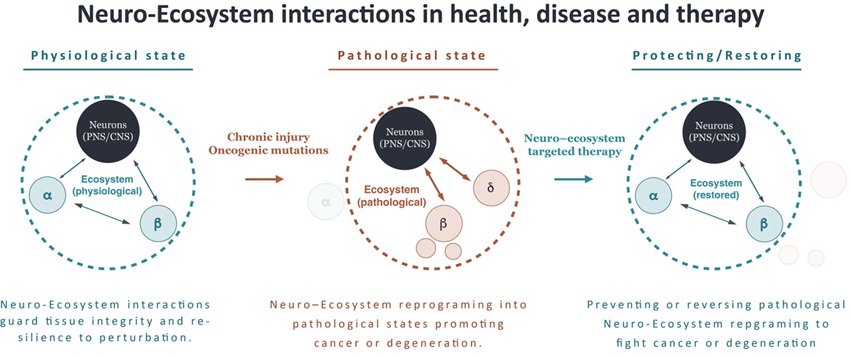
By combining in vivo targeted genetic manipulation with advanced in vitro 3D models, we aim to identify regulatory mechanisms that link intrinsic plasticity reactivation to ecosystem reprogramming. This is crucial not only for advancing our understanding of how complex tissues maintain function and integrity but also for developing new therapeutic strategies focused on preventing or reversing pathological Neuro-Ecosystem states in cancer and degenerative diseases.
Representative Publications
- Two distinct Epithelial to Mesenchymal Transition Programmes Control Invasion and Inflammation in Segregated Tumour Cell Populations. Kass Youssef, K., Narwade, N., Arcas, A., Marquez-Galera, A., Jiménez, R., Lopez-Blau, C., Fazilaty, H., García-Gutierrez, D., Cano, A., Galcerán, J., Moreno-Bueno, G., Lopez-Atalaya, J.P. and Nieto, M.A. Nature Cancer. 2024 https://doi.org/10.1038/s43018-024-00839-5
- The epithelial-mesenchymal transition in tissue degeneration and repair. Youssef, K.K. and Nieto, M.A. Nat. Rev. Mol. Cell. Biol. 2024 25, 720-739 https://doi.org/10.1038/s41580-024-00733-z
- A gene regulatory network to control EMT programs in development and disease Fazilaty H, Rago L, Kass Youssef K, Ocaña OH, Garcia-Asencio F, Arcas A, Galceran J, Nieto MA Nature Communications 2019 10:5115 https://doi.org/10.1038/s41467-019-13091-8
- Defining the clonal dynamics leading to mouse skin tumour initiation. Sánchez-Danés A, Hannezo E, Larsimont JC, Liagre M, Youssef KK, Simons BD, and Blanpain C. Nature. 2016 536: 298–303 https://doi.org/10.1038/nature19069
- Sox9 Controls Self-Renewal of Oncogene Targeted Cells and Links Tumor Initiation and Invasion. Larsimont JC, Youssef KK, Sánchez-Danés A, Sukumaran V, Defrance M, Delatte B, Liagre M, Baatsen P, Marine JC, et al. Cell Stem Cell. 2015 17: 60 - 73 https://doi.org/10.1016/j.stem.2015.05.008
- Distinct contribution of stem and progenitor cells to epidermal maintenance. Mascré G, Dekoninck S, Drogat B, Youssef KK, Brohée S, Sotiropoulou PA, Simons BD, Blanpain C. Nature. 2012 489, 257–262 https://doi.org/10.1038/nature11393
- Adult interfollicular tumour-initiating cells are reprogrammed into an embryonic hair follicle progenitor-like fate during basal cell carcinoma initiation. Youssef KK, Lapouge G, Bouvrée K, Rorive S, Brohée S, Appelstein O, Larsimont JC, Sukumaran V, Van de Sande B, Pucci D, Dekoninck S, Berthe JV, Aerts S, Salmon I, Del Marmol V, Blanpain C. Nature Cell Biology. 2012 14: 1282–1294 https://doi.org/10.1038/ncb2628
- A vascular niche and a VEGF–Nrp1 loop regulate the initiation and stemness of skin tumours. Beck B, Driessens G, Goossens G, Youssef KK, Loges S, Caauwe A, Kuchnio A, Sotiropoulou PA, Candi A, Mascre M, Haigh JJ, Carmeliet P, and Blanpain C. Nature. 2011 478, 399–403 https://doi.org/10.1038/nature10525
- Identifying the cellular origin of squamous skin tumors. Lapouge G*, Youssef KK*, Vokaer B, Achouri Y, Michaux C, Sotiropoulou PA, Blanpain C. PNAS. 2011 108 (18): 7431-7436 https://doi.org/10.1073/pnas.1012720108
- Identification of the cell lineage at the origin of basal cell carcinoma. Youssef KK*, Van Keymeulen A*, Lapouge G*, Beck B, Achouri Y, Michaux C, Sotiropoulou P and Blanpain C. Nat Cell Biol. 2010 12, 299–305 https://doi.org/10.1038/ncb2031

- Two distinct Epithelial to Mesenchymal Transition Programmes Control Invasion and Inflammation in Segregated Tumour Cell Populations. Kass Youssef, K., Narwade, N., Arcas, A., Marquez-Galera, A., Jiménez, R., Lopez-Blau, C., Fazilaty, H., García-Gutierrez, D., Cano, A., Galcerán, J., Moreno-Bueno, G., Lopez-Atalaya, J.P. and Nieto, M.A. Nature Cancer. 2024 https://doi.org/10.1038/s43018-024-00839-5
- The epithelial-mesenchymal transition in tissue degeneration and repair. Youssef, K.K. and Nieto, M.A. Nat. Rev. Mol. Cell. Biol. 2024 25, 720-739 https://doi.org/10.1038/s41580-024-00733-z
- A gene regulatory network to control EMT programs in development and disease Fazilaty H, Rago L, Kass Youssef K, Ocaña OH, Garcia-Asencio F, Arcas A, Galceran J, Nieto MA Nature Communications 2019 10:5115 https://doi.org/10.1038/s41467-019-13091-8
- Defining the clonal dynamics leading to mouse skin tumour initiation. Sánchez-Danés A, Hannezo E, Larsimont JC, Liagre M, Youssef KK, Simons BD, and Blanpain C. Nature. 2016 536: 298–303 https://doi.org/10.1038/nature19069
- Sox9 Controls Self-Renewal of Oncogene Targeted Cells and Links Tumor Initiation and Invasion. Larsimont JC, Youssef KK, Sánchez-Danés A, Sukumaran V, Defrance M, Delatte B, Liagre M, Baatsen P, Marine JC, et al. Cell Stem Cell. 2015 17: 60 - 73 https://doi.org/10.1016/j.stem.2015.05.008
- Distinct contribution of stem and progenitor cells to epidermal maintenance. Mascré G, Dekoninck S, Drogat B, Youssef KK, Brohée S, Sotiropoulou PA, Simons BD, Blanpain C. Nature. 2012 489, 257–262 https://doi.org/10.1038/nature11393
- Adult interfollicular tumour-initiating cells are reprogrammed into an embryonic hair follicle progenitor-like fate during basal cell carcinoma initiation. Youssef KK, Lapouge G, Bouvrée K, Rorive S, Brohée S, Appelstein O, Larsimont JC, Sukumaran V, Van de Sande B, Pucci D, Dekoninck S, Berthe JV, Aerts S, Salmon I, Del Marmol V, Blanpain C. Nature Cell Biology. 2012 14: 1282–1294 https://doi.org/10.1038/ncb2628
- A vascular niche and a VEGF–Nrp1 loop regulate the initiation and stemness of skin tumours. Beck B, Driessens G, Goossens G, Youssef KK, Loges S, Caauwe A, Kuchnio A, Sotiropoulou PA, Candi A, Mascre M, Haigh JJ, Carmeliet P, and Blanpain C. Nature. 2011 478, 399–403 https://doi.org/10.1038/nature10525
- Identifying the cellular origin of squamous skin tumors. Lapouge G*, Youssef KK*, Vokaer B, Achouri Y, Michaux C, Sotiropoulou PA, Blanpain C. PNAS. 2011 108 (18): 7431-7436 https://doi.org/10.1073/pnas.1012720108
- Identification of the cell lineage at the origin of basal cell carcinoma. Youssef KK*, Van Keymeulen A*, Lapouge G*, Beck B, Achouri Y, Michaux C, Sotiropoulou P and Blanpain C. Nat Cell Biol. 2010 12, 299–305 https://doi.org/10.1038/ncb2031