Español
Neuronal type-specific modulation of cognition and AP-1 signaling by early-life rearing conditions.
Researchers at the Institute for Neurosciences identify the molecular mechanisms linking early-life environments with memory
• The study, published in Nature Communications, reveals that the transcription factor AP-1 acts as a molecular ‘switch’ that converts early-life experiences into lasting cognitive improvements or impairments.
• Researchers found that blocking the Fos gene prevents mice from benefiting from an enriched environment, highlighting the essential role of AP-1 in neuronal plasticity.
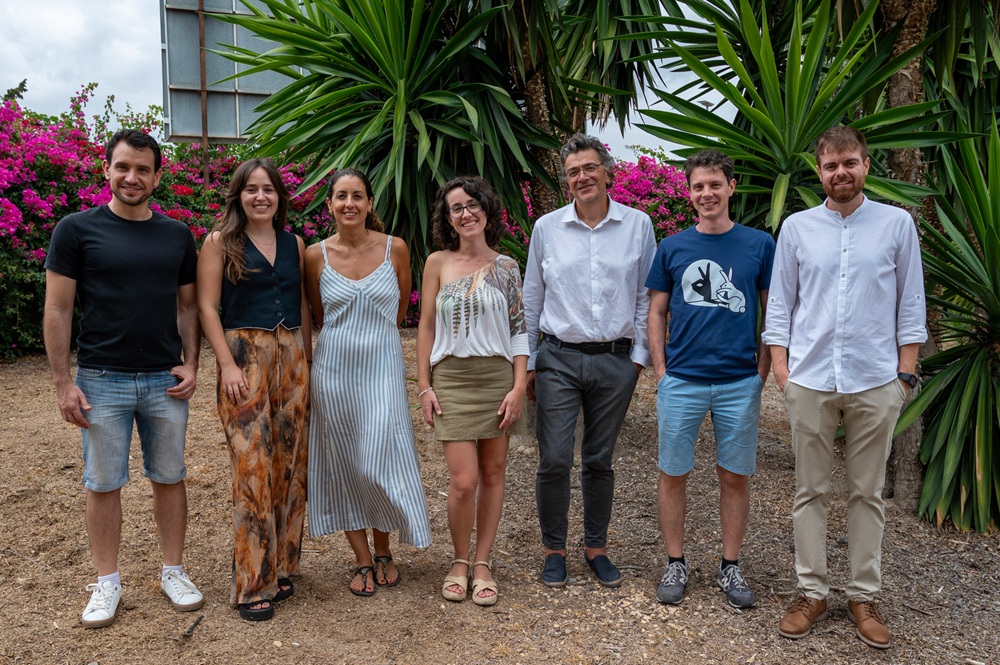
(Photo: IN CSIC-UMH researchers Sergio Niñerola, Isabel Bustos, Beatriz del Blanco, Marta Alaiz-Noya, Ángel Barco, Federico Miozzo & Miguel Fuentes. Source: IN CSIC-UMH)
A team from the Institute for Neurosciences (IN), a joint research center of the Spanish National Research Council (CSIC) and Miguel Hernández University of Elche (UMHH), led by researcher Ángel Barco, has identified a molecular mechanism that helps explain why growing up in a stimulating environment enhances memory. In contrast, a lack of stimulation can impair it. The study, conducted in mice and published in Nature Communications, demonstrates that the environment during childhood and adolescence has a lasting impact on the brain by activating or repressing a single transcription factor, AP-1, which regulates the expression of genes involved in neuronal plasticity and learning. This finding identifies a molecular mediator that can translate life experiences into persistent changes in cognitive function.
To carry out the research, the team from the IN’s Transcriptional and Epigenetic Mechanisms of Neuronal Plasticity laboratory raised young mice in three different conditions: an enriched environment with toys, exercise wheels, and social interaction; a standard environment; and an impoverished environment characterized by isolation and a lack of stimulation. After several weeks, animals raised in enriched environments showed superior performance in learning and memory tasks, whereas those reared in impoverished environments scored lower on cognitive tests.
Using advanced genomic and epigenetic techniques to analyse the brain, the researchers observed that early-life experiences produce long-lasting modulation of AP-1 activity: its activation boosts gene networks that strengthen neuronal connections, while reduced activity weakens those same processes. To functionally validate this finding, the team experimentally blocked the Fos gene, one of the essential subunits of the AP-1 complex. Under these conditions, mice did not benefit from the enriched environment. They showed no cognitive improvement—demonstrating that AP-1 is not only correlated with environmentally induced changes in the brain but is also required for them to occur.
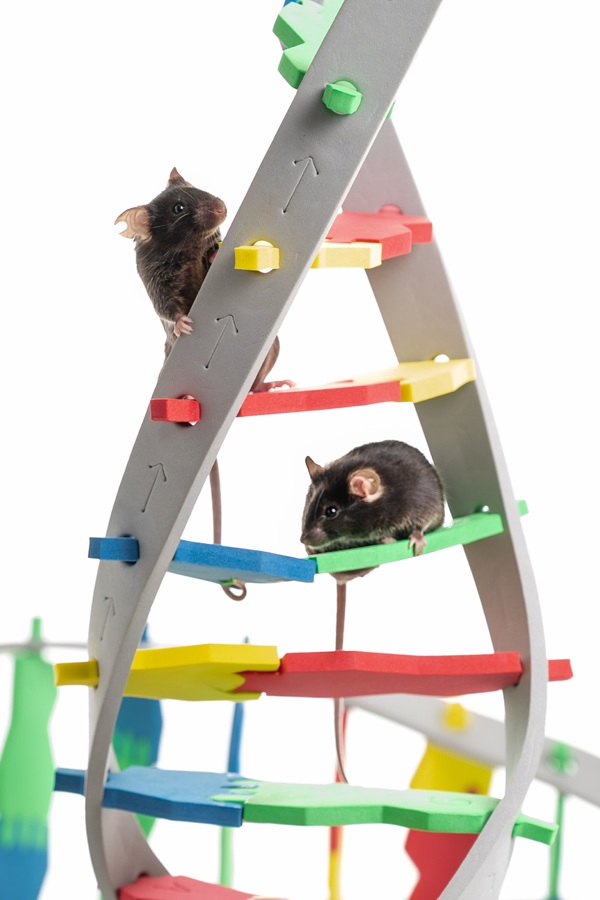
Mice raised in enriched environments show improved learning and memory driven by sustained activation of the transcription factor AP-1, the molecular ‘switch’ that converts early-life experiences into lasting changes in the brain. Source: IN CSIC-UMH.
“We have known for decades that the early-life environment influences learning capacity, but we lacked a clear mechanism to explain how this happens. We have now identified a molecular switch that translates those early experiences into long-lasting changes in the brain”, explains Barco. “What is striking is that a single transcription factor acts as a convergence point for such diverse experiences as sensory stimulation, exercise, or social interaction. It is a key piece in understanding how the environment shapes memory”, notes the study leader.
The study also reveals that environmental impact varies among neuronal populations. By analysing specific types of neurons, the scientists found that AP-1 responds differently in CA1 pyramidal neurons and in dentate gyrus granule cells, two key populations involved in spatial learning and memory formation. According to Marta Alaiz-Noya, co-first author of the study together with Federico Miozzo and Miguel Fuentes Ramos, “the robust activation of AP-1 in enriched environments triggers gene programmes that allow the brain to enter ‘learning mode’, reinforcing neuronal connections during particularly sensitive developmental stages”.
“Taken together, these findings reinforce the idea that environmental stimulation and social interaction during childhood and adolescence not only enrich life experience but also leave a tangible biological trace in the brain. Moreover, they open the door to future therapeutic strategies that mimic the effects of enriched environments in neurodevelopmental disorders or in conditions involving cognitive decline”, adds Federico Miozzo.
The article also involved researchers from the Faculty of Mathematics, Informatics, and Mechanics at the University of Warsaw (Poland), who contributed to the bioinformatic analysis of DNA methylation data across the three environments. The work was made possible thanks to funding from the “la Caixa” Foundation, the Spanish State Research Agency – Ministry of Science, Innovation and Universities, the Carlos III Health Institute, the European Regional Development Fund (ERDF) of the European Union, and the Generalitat Valenciana.
Source: Institute for Neurosciences CSIC-UMH (in.comunicacion@umh.es)