Español
Brain-wide mapping of developmental trajectories of cerebellar efferent projections.
Researchers map how the cerebellum builds its connections with the rest of the brain during early development
• The study, published in PNAS, presents a detailed map of how multiple cerebellar projections to the rest of the brain develop, identifying when and how these connections are established and consolidated.
• The results show that this connectivity emerges much earlier than expected, suggesting that the cerebellum may act as an early ‘hub’ essential for organizing the brain’s initial architecture.
(Photo: Top to bottom, left to right: Raquel Murcia Ramón, Ángeles Arzalluz Luque, Sergio Muñoz Cobos, Martina Riva, and Juan Antonio Moreno Bravo, researchers at the IN CSIC-UMH)
A team of researchers at the Institute for Neurosciences (IN), a joint center of the Spanish National Research Council (CSIC) and Miguel Hernández University of Elche (UMH), has reconstructed for the first time how the cerebellum establishes its connections with the rest of the brain during the earliest stages of life. The work, published in the journal Proceedings of the National Academy of Sciences (PNAS), describes in detail the phases in which these neural connections emerge, expand, and are refined, offering the first comprehensive map of the development of cerebellar projections across the mouse brain.
Although the cerebellum has traditionally been associated with motor control, growing evidence shows that it also plays a role in processes such as emotional regulation, social behavior, and other cognitive functions. However, until now, it was not precisely known when it began interacting with other regions of the brain, communication that is fundamental for these cerebellar roles. This gap motivated the work of the group Development, Wiring and Function of Cerebellar Circuits, led by Juan Antonio Moreno Bravo at the IN.
Three key stages
The team has shown that the pathways connecting the cerebellum with other brain areas develop following a highly organized pattern: “We observed that cerebellar projections begin to form very early, already in the embryo, when the first axons start connecting with their target regions”, explains Moreno Bravo. These connections then expand rapidly and massively, accompanying the intense brain growth that takes place during these early stages.
Finally, during the first postnatal weeks, the circuits undergo a refinement period in which the definitive connections are consolidated. “This stepwise sequence allowed us to pinpoint the periods when the cerebellum may start influencing other brain regions, even while it is still in an immature developmental stage. These early periods represent highly relevant windows for understanding how the brain establishes its internal architecture”, adds the researcher.
This work was made possible thanks to a combination of cutting-edge genetic tools and whole-brain three-dimensional imaging techniques. Using specific fluorescent markers, the researchers labeled the different neurons of the deep cerebellar nuclei, the main output pathway of the cerebellum. They then applied advanced tissue-clearing and microscopy methods to visualize the axons in three dimensions and track their trajectory from origin to target regions.
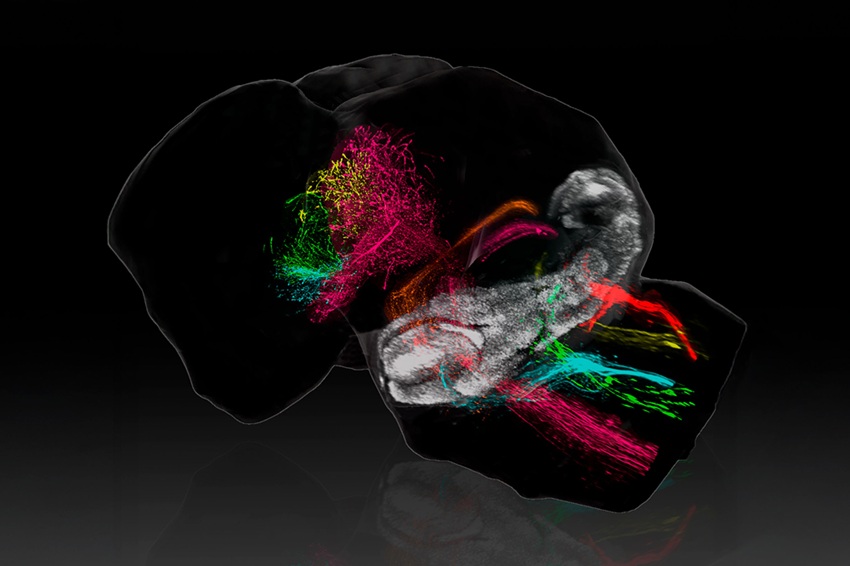
The image shows how the cerebellum (white) sends its projections across the brain of a newborn mouse. A wide network of color-coded axons reveals how this tiny structure connects with multiple brain regions during a critical period of early development. Source: IN CSIC-UMH
“Seeing these projections in 3D, how they emerge in the embryo and spread throughout the brain, was truly fascinating”, says Raquel Murcia Ramón, first author of the study. “Many of these connections had never been seen with such precision, and being able to observe their evolution in time allowed us to reconstruct a full developmental story of these circuits”, she adds.
Beyond the detailed mapping, the results point to a broader idea: the cerebellum may play a much earlier and more influential role in shaping the developing brain than previously thought. “It has traditionally been assumed that the cerebellum matures late and that its involvement in complex functions emerges gradually and only at later stages. Our work suggests the opposite: the cerebellum begins building its network very early and may already be actively contributing to the formation of circuits in other brain regions from initial developmental phases”, explains Moreno Bravo. This perspective, he argues, “may help us rethink the role of the cerebellum in development, not as a late modulator of movement, but as an early node contributing to the construction of broader brain networks”.
The map generated by the IN CSIC-UMH team constitutes a reference tool for understanding how cerebellar connectivity is structured from the very beginning of life. In addition, it provides a detailed temporal framework to investigate how early experiences, genetic factors, or environmental conditions may alter the developing cerebellum and, consequently, the neural networks it connects with. “This work lays the groundwork for exploring not only how the cerebellum contributes to typical brain development, but also how cerebellar alterations could give rise to pathological conditions, including some linked to neurodevelopmental disorders”, researchers note.
This study was supported by funding from the European Research Council (ERC) under the European Union’s Horizon 2020 research and innovation program, the Spanish State Research Agency (AEI) – Ministry of Science, Innovation and Universities, and the Severo Ochoa Program for Centers of Excellence.
Source: Institute for Neurosciences CSIC-UMH (in.comunicacion@umh.es)