
 Español
Alicante brings together leading international experts in neuroscience at the first Systems-IN-Action Meeting, a conference on the brain in action
20 de March de 2026
Sant Joan d'Alacant hosted more than 140 experts at the Systems-IN-Action Meeting, an international conference focused on the latest advances in systems neuroscience and on studying the brain in action during behavior. Held from March 16 to 18, the meeting was promoted by the Institute for Neurosciences (IN), a joint center of the Spanish National Research Council (CSIC) and the Miguel Hernández University of Elche (UMH), within the framework of the Severo Ochoa Centres of Excellence Programme.
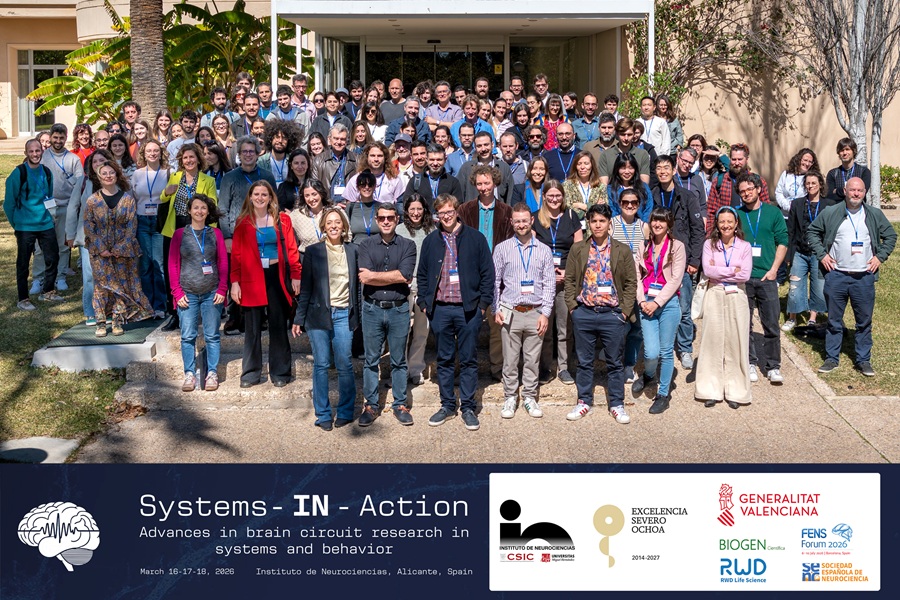
Group photo of the organizers and participants of the first Systems-IN-Action Meeting, held from March 16 to 18 in Sant Joan d’Alacant. Source: IN CSIC-UMH.
At a time of profound transformation in neuroscience, this conference brought together leading researchers from around the world who use state-of-the-art tools to study the brain in action. The integration of new experimental technologies with computational methods is enabling advances in understanding how neural circuits process sensory information, generate perceptions, and give rise to actions and behavior. “This meeting aims to bring together experts working at different levels of brain analysis to jointly address how neural activity is translated into behavior”, explain the conference organizers: Isabel Pérez-Otaño, who leads the Plasticity and remodeling of neural circuits laboratory and the scientific programme Synaptic modulation of neural circuits and behavior; Ramón Reig, who leads the Sensory-motor processing by subcortical areas laboratory; and Andreas Kardamakis, who leads the Neural circuits in vision for action laboratory.
Over three days, the scientific programme was structured into five thematic sessions covering different levels of organization of the nervous system, from the activity of neural circuits to their impact on behavior. This integrative approach helped bridge experimental and theoretical perspectives, fostering the exchange of ideas between established researchers and early-career scientists, and promoting new ways of understanding how the brain generates behavior.
The meeting featured leading international figures such as Matteo Carandini, from University College London (UK); Megan Carey, from the Champalimaud Foundation (Portugal); Tony Zador, from Cold Spring Harbor Laboratory (USA); and Marie Carlén, from the Karolinska Institutet (Sweden), among others. They addressed key topics, including how neural networks in the brain are organized and function, the development of predictive brain models using artificial intelligence, and new theoretical approaches to understanding neural systems.
As a highlight, the conference included a panel discussion on the impact and future of artificial intelligence in neuroscience. In this session, experts discussed how these tools are transforming data analysis, neuronal modelling, and the understanding of complex cognitive processes. The programme was further enriched by a strong poster session and short talk sessions, in which Institute for Neurosciences researchers John Wesseling, Andreas Kardamakis, Ramón Reig, Félix Leroy, and Isabel del Pino presented the latest advances in their research lines. These contributions reflected the diversity of research at the institute and provided a valuable platform for the direct exchange of results, fostering interaction between established and early-career researchers.
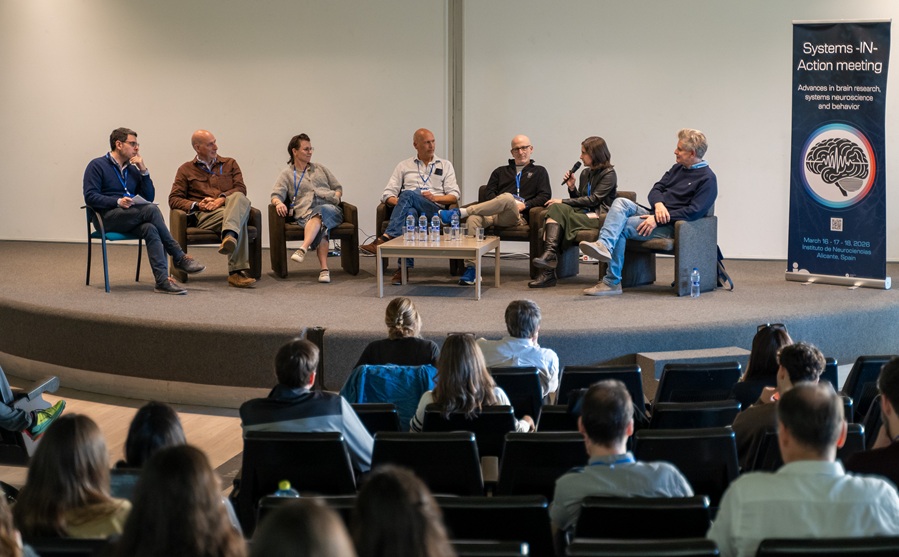
Researchers Andreas Kardamakis, Matteo Carandini, Marie Carlén, John Wesseling, Tony Zador, Megan Carey, and Michael Hausser during the panel discussion on whether artificial intelligence (AI) and deep learning models can help to understand brain function. Source: IN CSIC-UMH.
With this initiative, the Institute for Neurosciences CSIC-UMH reinforces its commitment to research excellence and to promoting international scientific forums that contribute to advancing knowledge of the brain. The Systems-IN-Action Meeting was supported by the Severo Ochoa Centres of Excellence Programme at the Institute for Neurosciences, the Generalitat Valenciana, the Federation of European Neuroscience Societies (FENS), the Spanish Society for Neuroscience (SENC), as well as the companies BIOGEN Científica and RWD Life Science.
For more information: see the programme in the attached document (PDF file)
Source: Institute for Neurosciences CSIC-UMH (in.comunicacion@umh.es)