
 Español
Alicante brings together young researchers at the FENS-Hertie Winter School on advanced technologies for understanding brain diversity
19 de January de 2026
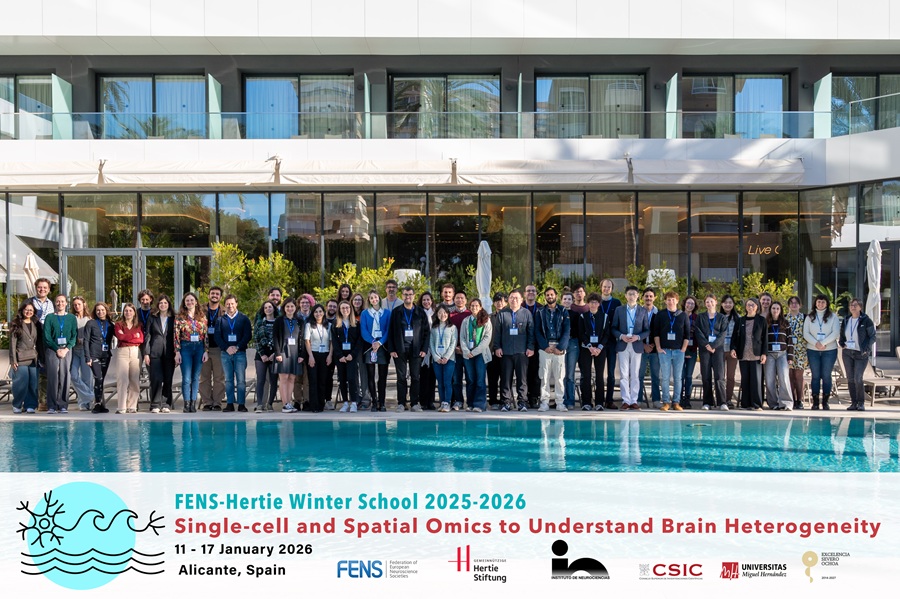
Participants at the FENS-Hertie Winter School in Alicante, January 11–17. Photo credit: IN CSIC-UMH
The Institute for Neurosciences (IN), a joint center of the Spanish National Research Council (CSIC) and Miguel Hernández University of Elche (UMH), hosted the FENS-Hertie Winter School 2025–2026 in Alicante from January 11 to 17. This international advanced training event, titled ‘Single-cell and Spatial Omics to Understand Brain Heterogeneity,’ brought together PhD students and postdoctoral researchers from several countries. The scientific program was organized by Gonçalo Castelo-Branco (Karolinska Institute, Sweden) and Ana Mendanha Falcao (University of Minho, Portugal).
During an intensive week of activities, participants received specialized training in the most cutting-edge single-cell and spatial omics methodologies, including transcriptomics, epigenomics, lipidomics, and proteomics, applied to the study of the brain. These technologies are transforming our understanding of cellular heterogeneity in the nervous system, as well as the mechanisms underlying its normal functioning and various neurological disorders.
The academic program combined lectures delivered by internationally leading scientists, hands-on sessions, participant presentations, and spaces for scientific discussion, fostering a highly interactive and collaborative environment. This format allowed not only the acquisition of advanced technical knowledge but also the exchange of ideas and the establishment of new collaborative networks in the emerging field of neuro-omics, a set of disciplines that use high-throughput technologies to study the brain at molecular and cellular scales.
Among the activities carried out, a practical computational session focused on the analysis of spatial omics data stood out. The session, titled ‘Computational Pipelines for Spatial Omics Data,’ was led by José P. López-Atalaya, head of the Cellular Plasticity and Neuropathology laboratory at the IN, together with Ángel Márquez-Galera, head of the institute’s Systems Administration and Bioinformatics Service, Violeta Duran Laforet, a postdoctoral researcher in the Cellular Plasticity and Neuropathology laboratory, and Lorenzo Puche-Aroca, a PhD researcher in the Development, Plasticity and Reprogramming of Sensory Circuits laboratory. During this practical session, participants had the opportunity to work directly with computational tools for the analysis and interpretation of these complex data.
According to the local organizers of the event, Guillermina López-Bendito, Francisco Martini, and Silvia De Santis, researchers at the IN, hosting a FENS Winter School in Alicante, represent “recognition of the Institute for Neurosciences role in European neuroscience research and provide an exceptional opportunity to train the next generation of researchers in technologies that are transforming the field”. They also emphasize that ‘the international nature of the course and the diversity of participants’ backgrounds greatly enrich scientific exchange and strengthen the institute’s international profile.
The FENS-Hertie Winter School is part of the advanced training program promoted by the Federation of European Neuroscience Societies (FENS), in collaboration with the Hertie Foundation, a prestigious German foundation dedicated to promoting excellence in biomedical research. This edition of the event was co-organized by the Institute for Neurosciences (CSIC–UMH), further establishing Alicante as a hub for excellence in neuroscience training at the European level.
Source: Institute for Neurosciences CSIC-UMH (in.comunicacion@umh.es)